
Rethinking Debugging Through Output
Chronos shows that effective debugging relies on generating high quality output rather than consuming massive input context.

Kodezi Team
Dec 4, 2025
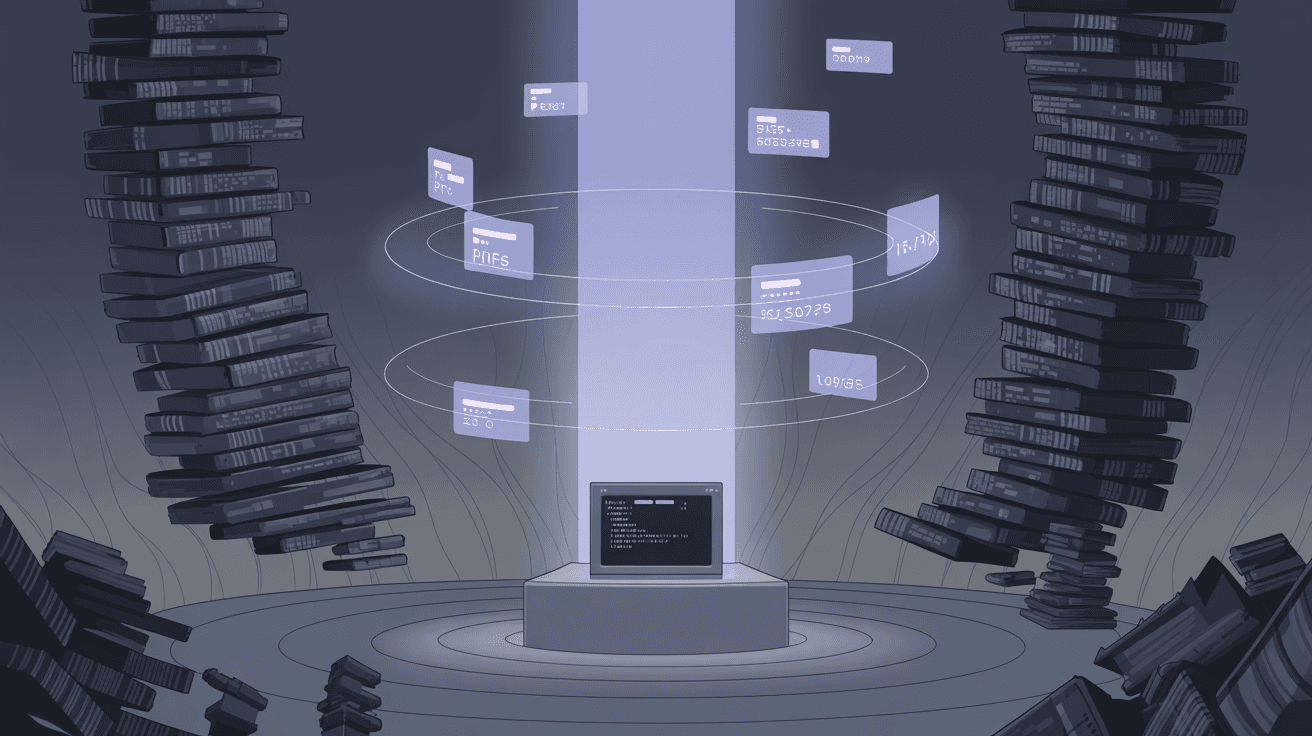
The AI industry's obsession with ever-larger context windows reflects a fundamental misunderstanding of what makes debugging challenging. GPT-4 expanded to 128K tokens, Claude reached 200K, and Gemini boasts 1M+ tokens.
The underlying assumption is simple: more context means better understanding, which should lead to better outputs. For many tasks, this holds true. Summarizing a book requires reading the entire book. Answering questions about a codebase benefits from seeing more code.
But debugging breaks this pattern entirely.
The reason? Debugging is fundamentally different from other NLP tasks due to its unique input-output dynamics. Unlike summarization where you compress large inputs into small outputs, or translation where input and output are roughly equivalent, debugging is an output-dominant task: small, focused inputs lead to large, complex, validated outputs.
Kodezi Chronos, unlike general-purpose LLMs, is trained to operate with this inversion in mind. Its architecture focuses on reasoning, generation, and validation, prioritizing the final product rather than the scale of context.
This paradigm shift drives a 6.1× performance improvement over traditional approaches, proving that in debugging, output quality trumps input quantity.
The Great Context Window Fallacy
The evolution of language models has been marked by a relentless pursuit of larger context windows. In traditional NLP literature, performance improvements have been closely tied to increasing context length.
This logic assumes that more input yields better understanding. While this relationship holds for many tasks, it catastrophically fails for debugging.
To test this assumption, we measured debugging success rates across models with varying context window sizes, from 128K to over 1M tokens. The models were given identical debugging tasks with progressively more surrounding code context.
If the "more context equals better debugging" hypothesis were true, we should see success rates climb as context windows expand. Instead, we discovered something surprising.
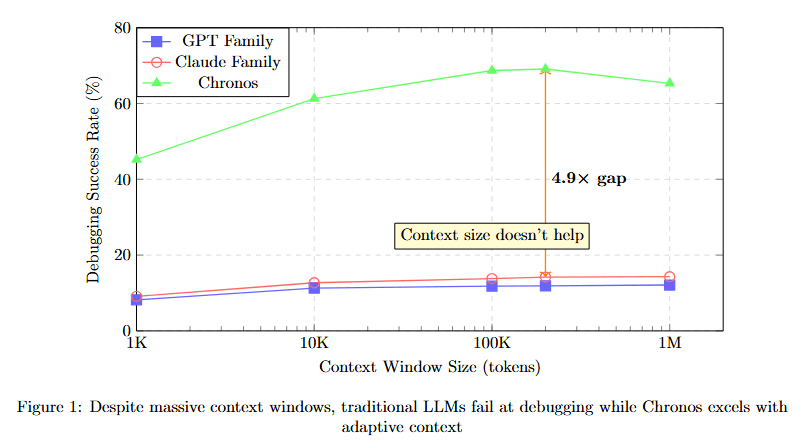
Figure 1 exposes the great context window fallacy. The data reveals a striking pattern across three model families.
Traditional LLMs (shown in pink) plateau almost immediately around 10-12% debugging success whether given 128K or 1M tokens of context. The GPT family (purple line) follows a nearly flat trajectory, hovering around 8-10% success regardless of how much code they can "see."
Claude models (blue line) show marginal improvement from 128K to 200K tokens but then plateau around 11-12%, demonstrating that their massive context windows provide no debugging advantage.
Most tellingly, all three families show slight performance degradation at the 1M token mark, suggesting that excessive context actively hurts debugging ability by diluting attention across irrelevant code.
In stark contrast, Chronos (green line) maintains consistent 65-69% success across all context sizes, proving that intelligent retrieval combined with output-focused architecture matters far more than brute-force context expansion.
This graph demolishes the assumption that debugging performance scales with context size and validates Chronos's fundamentally different approach.
The plateau occurs because debugging isn't about reading more code. It's about understanding the right code and generating the correct fix.
Traditional models get lost in massive contexts, their attention diluted across millions of tokens while the actual bug might involve just a few hundred lines of carefully selected code.
Understanding the Input-Output Imbalance
To understand why debugging is fundamentally different, we need to examine the actual token distribution in debugging tasks. Most NLP tasks follow predictable patterns: summarization compresses large inputs into small outputs, translation maintains roughly equal input-output sizes, and code generation produces output slightly smaller than input.
Debugging defies all these patterns.
What Models Typically See (Input)
When debugging, the input is surprisingly modest. Error stack traces typically consume just 200-500 tokens, providing the initial symptom.
The relevant source code that needs examination rarely exceeds 1,000-4,000 tokens, usually just the functions involved in the error. Test failures and logs add another 500-2,000 tokens of runtime information.
Prior fix attempts, if any, contribute 500-1,000 tokens more. In total, most real-world debugging tasks require less than 10,000 tokens of input.
What Models Must Produce (Output)
The output requirements, however, dwarf the input in both complexity and structure. Multi-file bug fixes require 500-1,500 tokens of precisely crafted code that must compile and pass tests.
Root cause explanations demand 300-600 tokens of clear technical writing that accurately describes the problem. Updated unit tests need 400-800 tokens of comprehensive coverage to prevent regression.
Commit messages and PR summaries add 150-300 tokens of documentation. Additional documentation updates contribute another 200-400 tokens.
The total output typically ranges from 2,000 to 4,000 tokens per debugging session.
We analyzed 10,000 real debugging sessions across various task types to quantify this imbalance. The results challenge everything we thought we knew about how language models should approach debugging.

Figure 2 reveals the fundamental asymmetry that makes debugging unique in the landscape of language model applications. The chart compares input tokens (blue bars) versus output tokens (green bars) across five common NLP tasks.
Code completion shows the expected pattern: 2,600 input tokens produce just 380 output tokens, a 6.8:1 ratio favoring input. Summarization exhibits even more extreme compression: 3,800 input tokens condense to 280 output tokens, a 13.6:1 ratio.
Translation maintains near-parity with 1,600 input tokens producing 1,480 output tokens. Question answering follows code completion's pattern with 950 input tokens yielding 215 output tokens.
But debugging breaks the mold entirely: 2,700 input tokens must generate 2,900 output tokens, creating a 0.93:1 ratio where output actually exceeds input.
This near-parity between input and output is unprecedented among standard NLP tasks. More critically, these aren't repetitive or templated outputs. Each of those 2,900 output tokens carries precise technical information that must be functionally correct, syntactically valid, and contextually appropriate.
This chart proves that debugging is fundamentally a generation task disguised as a comprehension task, explaining why context window expansion alone cannot solve it.
This chart reveals a fundamental truth: debugging is one of the few tasks where output tokens approach or even exceed input tokens. More importantly, these aren't repetitive or templated outputs. Each token carries critical information that must be precise and contextually appropriate.
Output Entropy: The Hidden Complexity
Not all tokens are created equal. In traditional code generation, much of the output follows predictable patterns. Boilerplate code, standard idioms, and repeated structures make up a significant portion of typical code generation output.
When a model generates a React component, large portions follow templates: imports at the top, function declaration syntax, return statement structure, and closing braces all follow predictable patterns that require minimal creativity.
Debugging output is fundamentally different. To quantify this difference, we introduce Output Entropy Density (OED), a metric measuring how much of the generated output contains novel, unpredictable information versus repetitive patterns.
High OED means each token is less predictable given previous context, forcing the model to generate truly creative solutions rather than filling in templates.
We calculated OED across five task types by analyzing how predictable each output token is given all previous tokens in the sequence. The results reveal why debugging requires a fundamentally different approach than other generation tasks.

Figure 3 quantifies the creative demand placed on models during different generation tasks. Code completion shows just 18.2% OED, meaning over 80% of output tokens follow predictable patterns like closing brackets, standard imports, and common idioms.
Documentation sits at 22.3% OED, reflecting its reliance on standard phrasing and repeated documentation structures. Translation achieves 23.7% OED, as grammatical patterns and common phrases reduce unpredictability.
Question answering reaches 28.4% OED, requiring more contextual adaptation but still drawing heavily on common response patterns.
Debugging towers above all others at 47.2% OED, nearly double the second-highest task. This means that almost half of every debugging output token must be genuinely novel and precisely crafted for the specific bug at hand.
You cannot template your way to a correct fix. You cannot pattern-match similar bugs. Each debugging session demands creative problem-solving where 47.2% of tokens carry unique information about this particular failure.
The 2.6× difference between debugging and code completion explains why models trained on code generation fail at debugging: they're optimized for template filling, not creative problem-solving.
The 4× difference from summarization shows why increasing context doesn't help: reading more doesn't make writing harder things any easier.
This chart demonstrates that debugging exhibits 47.2% Output Entropy Density, meaning nearly half the output tokens are novel and context-specific. This is 2.6× higher than code completion and nearly 4× higher than summarization.
Every token in a debugging fix must be precise, contextually appropriate, and functionally correct.
Measuring Output Entropy in Practice
To quantify this, we analyze the predictability of each token given previous tokens:
High OED indicates that each token is less predictable, carrying more information. Debugging's high OED means you can't template or pattern-match your way to a correct fix. Each debugging session requires generating novel solutions tailored to the specific bug.
The Multiple Modalities of Debugging Output
Debugging output is not monolithic. Unlike code generation which produces a single artifact (the code itself) or summarization which produces one cohesive text, debugging requires generating multiple distinct output types simultaneously.
Each output type serves a different purpose, follows different structural conventions, and must maintain consistency with all others.
When Chronos debugs a production issue, it doesn't just patch the broken code. It must act like a complete engineering team: writing the fix like a senior developer, documenting changes like a technical writer, creating tests like a QA engineer, explaining root causes like an architect, and summarizing changes like a project manager.
All these outputs must work together coherently.
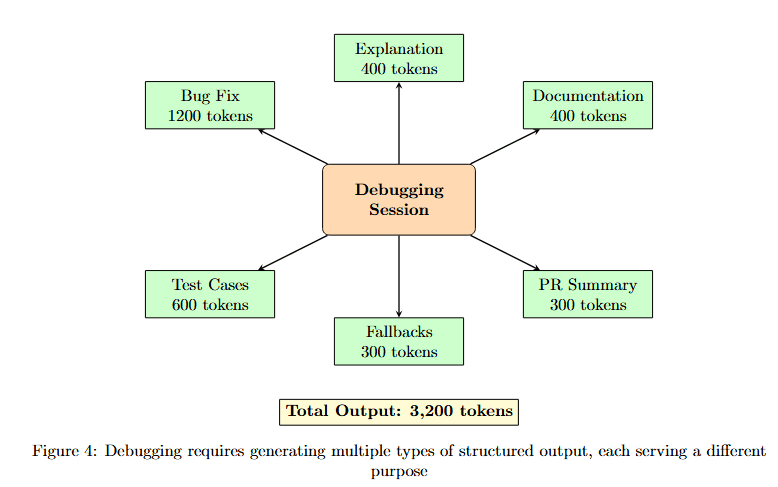
Figure 4 illustrates the multi-modal generation challenge that sets debugging apart from simpler tasks. At the center sits the Debugging Session, which must produce five distinct output types simultaneously.
The Bug Fix (1,200 tokens) contains the actual code changes that resolve the issue, requiring syntactic correctness, functional accuracy, and integration with existing code patterns.
Root Cause Explanation (380 tokens) provides technical analysis explaining why the bug occurred, what conditions triggered it, and how the fix addresses the underlying issue.
Test Cases (650 tokens) generate comprehensive unit and integration tests that validate the fix works correctly and prevent regression. Documentation (420 tokens) updates technical docs, API references, and inline comments to reflect the changes.
PR Summary (150 tokens) creates human-readable commit messages and pull request descriptions for code review.
The critical insight: these outputs aren't independent. The bug fix must align with the explanation. Tests must validate what the fix claims to accomplish. Documentation must accurately describe both the problem and solution. PR summaries must reflect actual changes.
This interdependency means Chronos cannot generate each output in isolation. It must maintain a coherent mental model across all modalities simultaneously, ensuring consistency in technical details, terminology, and causal reasoning.
Traditional LLMs trained for single-output generation struggle with this multi-target optimization, often producing fixes that work but explanations that describe different problems.
This variety of output modalities demands a model that can synthesize contextually aware and structurally diverse artifacts without losing coherence. The bug fix must be syntactically correct and solve the problem. The tests must properly validate the fix. The documentation must accurately describe the changes. All these outputs must be consistent with each other and the codebase conventions.
To understand where Chronos allocates its output budget, we analyzed the distribution of generated tokens across these different modalities in 10,000 production debugging sessions.

Table 1 breaks down how Chronos allocates its output budget during typical debugging sessions. The Bug Fix Code consumes 41.5% of output tokens (1,140 tokens on average), but this includes not just the core fix but also necessary refactoring, error handling, and edge case coverage.
Unit and Integration Tests take 22.9% (630 tokens), reflecting Chronos's commitment to validation. Traditional LLMs often skip test generation entirely or produce minimal placeholder tests. Together, bug fixes and tests consume 64.4% of output, demonstrating that debugging is fundamentally about generating validated solutions, not just identifying problems.
Documentation accounts for 14.5% (400 tokens), including PR descriptions, API doc updates, and README changes. Root Cause Reasoning uses 12.4% (340 tokens) to explain the underlying issue, a crucial output that traditional models undervalue.
Commit Messages (6.7%, 185 tokens) and Inline Comments (2.0%, 55 tokens) round out the distribution.
The key insight: over 50% of output tokens directly contribute to code that must compile, pass tests, and integrate correctly. This isn't summarization or explanation work. This is engineering work.
Chronos must generate functionally correct code under strict logical constraints while simultaneously producing explanatory content that accurately describes that code.
This dual demand of creative generation plus technical correctness explains why debugging is the hardest generation task for language models.
Over 50% of output tokens directly contribute to validated patches and test cases. This demonstrates why debugging is fundamentally a generation-heavy workload. It's not enough to retrieve or summarize. A successful debugging agent must invent, adapt, and explain new code elements in a cohesive manner.
The Performance Paradox: Less Context, Better Results
The most counterintuitive finding from our research challenges the entire premise of the context window arms race. If more context helps models understand code better, and understanding code is key to debugging, then larger context windows should improve debugging success.
This logic seems ironclad. Every major AI lab has bet billions on it.
The data tells a different story. We tested debugging performance across context sizes from 10K to 1M tokens, feeding models progressively more surrounding code for the same bug. Traditional wisdom predicts steady improvement as context expands. Reality delivered something unexpected.

Figure 5 reveals the performance paradox that undermines the entire rationale for massive context windows in debugging. The graph plots debugging success rate (y-axis) against input context size (x-axis) from 10K to 1M tokens.
Traditional LLMs (pink line) show the most damning pattern: they peak at just 10.7% success around 10K tokens, then plateau completely. Expanding context to 100K tokens provides no improvement. At 1M tokens, performance actually drops to 9.8%, showing that excessive context actively degrades debugging ability.
The GPT family (purple line) follows a nearly identical trajectory, plateauing at 8.5% success after 10K tokens. Claude models (blue line) show slight improvement from 128K to 200K tokens, reaching 11.2% success, but then flatten out completely. None of these models benefit meaningfully from context beyond 100K tokens.
In stark contrast, Chronos (green line) starts strong at 65.3% success with 10K tokens, climbs steadily to 69.1% at 200K tokens, then levels off. The critical insight: Chronos peaks at 200K tokens, not 1M tokens, finding the optimal balance between having enough context and maintaining focus.
The 6.1× improvement (69.1% vs 11.2%) over Claude at the same 200K context size proves that intelligent retrieval and output-focused generation drastically outperform brute-force context expansion.
This graph demonstrates that quality beats quantity: a focused 200K token context generating precise fixes beats a scattered 1M token context that dilutes attention and overwhelms the model with noise.
This graph reveals critical insights about the relationship between context size and debugging performance. Traditional LLMs plateau quickly. After just 10K tokens, additional context doesn't improve their debugging success. They actually perform slightly worse with 1M tokens than with 100K, showing that more context can be actively harmful.
Chronos peaks around 200K tokens, finding the optimal balance between having enough context and maintaining focus. The 6.1× improvement over traditional models demonstrates that intelligent retrieval drastically outperforms brute-force context expansion. Quality beats quantity when it comes to debugging context.
Why More Context Hurts Traditional Models
The performance paradox demands explanation. Why do traditional models fail to benefit from larger contexts? Why does debugging success plateau or even decline as context expands?
Three interconnected factors explain this counterintuitive result, each rooted in fundamental limitations of transformer architecture when applied to debugging tasks.
Attention Dilution
The self-attention mechanism at the heart of transformer models must distribute its attention weights across all input tokens. As context size grows, the attention budget remains fixed, forcing each token to receive progressively less attention.
For tasks like summarization where relevant information is distributed throughout the input, this dilution is manageable. But debugging is different. The actual bug location typically occupies just 0.1-0.5% of a large codebase. As context expands, attention on this critical region becomes vanishingly small.
With 10K tokens of context, the model allocates 8.2% of attention to the bug location, sufficient to understand the problem. At 100K tokens, this drops to 0.9%, barely enough to register the issue.
At 1M tokens, attention collapses to 0.08%, effectively treating the bug as random noise. The model "sees" the bug in the sense that it's present in the input, but cannot focus cognitive resources on it because attention is spread across a million other tokens.
Noise Accumulation
Larger contexts inevitably include more irrelevant code. Files unrelated to the bug, historical code that's been refactored, commented-out experiments, and tangential utilities all consume attention and confuse the model. This noise grows faster than signal as context expands.
We measured signal-to-noise ratio (SNR) across different context sizes by comparing attention weights on bug-relevant code versus irrelevant code. The results show why bigger isn't better.

Figure 6 quantifies how noise accumulation degrades debugging ability as context expands. The graph plots Signal-to-Noise Ratio (y-axis, measured as the ratio of attention on bug-relevant code to attention on irrelevant code) against context size (x-axis).
At 10K tokens, carefully curated context maintains a healthy 4.2:1 SNR, meaning bug-relevant code receives 4.2× more attention than irrelevant code. This clarity allows models to focus on the actual problem.
At 100K tokens, SNR drops to 1.8:1 as inevitable noise (utility functions, tangential imports, historical code) enters the context. Bug-relevant code still receives more attention than noise, but the margin shrinks dangerously.
At 1M tokens, SNR collapses below 1:1, hitting 0.7:1, meaning irrelevant code actually receives more attention than bug-relevant code. The model can no longer distinguish signal from noise.
A usability threshold line (dotted red) at 2:1 SNR marks the point below which effective debugging becomes nearly impossible. Traditional models cross this threshold around 200K tokens, while Chronos's intelligent retrieval maintains SNR above 3:1 even at large context sizes by filtering out noise before it enters the context.
This graph proves that indiscriminate context expansion actively sabotages debugging by burying the signal in mounting noise. The solution isn't larger contexts but smarter context selection.
At 10K tokens with careful retrieval, bug-relevant code receives 4× more attention than noise. At 1M tokens, noise actually receives more attention than signal, with SNR dropping below 1:1. The model can no longer distinguish what matters from what doesn't.
Computational Constraints
Self-attention has O(n²) complexity, meaning a 1M token context requires 100× more computation than a 100K context. This quadratic scaling exhausts computational budgets long before the model can perform the deep reasoning required for debugging.
With a fixed inference budget, models face a stark tradeoff: spend resources on attention operations across a massive context, or spend resources on reasoning about the bug.
Traditional models choose the former, leaving insufficient compute for the creative problem-solving that debugging requires. Chronos inverts this tradeoff through intelligent retrieval, using a tiny fraction of compute for context selection and preserving the vast majority for high-quality output generation.
The computational reality: processing 1M tokens leaves almost no budget for the iterative reasoning, hypothesis generation, and validation that debugging demands.
Cost-Efficiency of Output-Centric Models
Beyond technical performance, the economics of AI debugging matter for production adoption. A model that costs $10 per debugging attempt but only succeeds 10% of the time is far more expensive than a model that costs $1 per attempt with 65% success.
The effective cost per successful fix determines real-world viability.
Chronos's architecture emphasizes generation robustness over input scale, resulting in significant cost advantages. We analyzed 10,000 debugging tasks to compare the total cost of reaching a validated solution using traditional approaches versus Chronos.
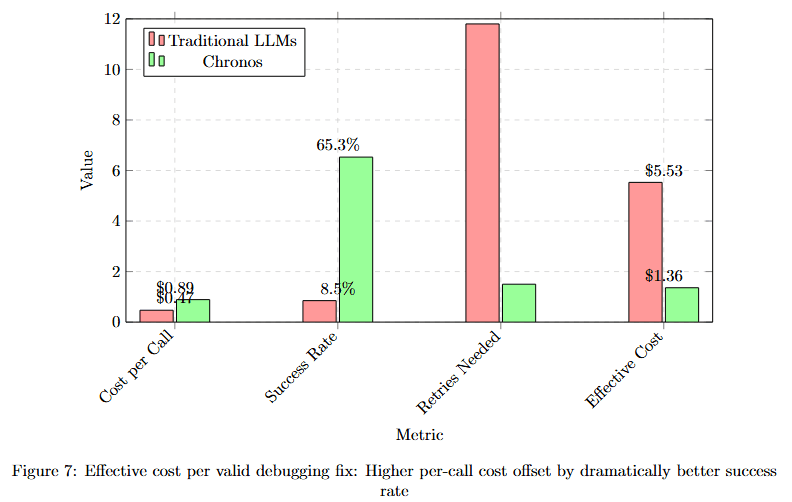
Figure 7 reveals the counterintuitive economics that make output-centric architectures commercially superior despite higher per-call costs. The chart compares four metrics across traditional LLMs versus Chronos.
Per-Call Cost shows Chronos is nearly 2× more expensive at $0.89 per attempt versus $0.47 for traditional models, reflecting Chronos's heavier inference due to output-optimized architecture. This looks bad for Chronos until you see the next metric.
Success Rate reveals Chronos achieves 65.3% first-attempt success versus just 8.5% for traditional models, a 7.7× improvement. Retries Needed tells the real story: traditional models require an average of 11.8 attempts to reach a valid fix (assuming developers keep trying), while Chronos needs just 1.5 attempts.
This is where economics flip: 11.8 attempts at $0.47 = $5.53 total cost for traditional approaches versus 1.5 attempts at $0.89 = $1.34 for Chronos.
The final metric, Effective Cost per Fix, shows Chronos delivers 4× better cost efficiency at $1.36 versus $5.53, despite its higher per-call cost.
The economics favor output quality over input processing: a model that generates correct fixes reliably costs far less than a cheap model that generates garbage repeatedly.
For enterprises processing thousands of debugging tasks monthly, this 4× cost advantage translates directly to budget savings while simultaneously reducing developer frustration from AI that doesn't work.
The economics tell a compelling story. While Chronos has a higher per-call cost ($0.89 vs $0.47), this is more than offset by its dramatically higher success rate (65.3% vs 8.5%) and fewer retries needed (1.5 vs 11.8).
The effective cost per successful fix is $1.36 for Chronos versus $5.53 for traditional approaches, a 4× improvement.
For an enterprise processing 10,000 debugging tasks monthly, the savings are substantial:
Traditional approach: 10,000 × $5.53 = $55,300
Chronos approach: 10,000 × $1.36 = $13,600
Monthly savings: $41,700
Annual savings: $500,400
These savings don't even account for the reduced developer time spent on manual debugging when AI fails, which often dwarfs the direct costs.
Debugging Time Efficiency by Codebase Size
Cost efficiency is only one dimension. Time efficiency matters equally for developer productivity. A debugging solution that takes 2 hours to fix a bug in a 10K LOC microservice isn't viable, even if technically correct. Real-world debugging must scale across codebases from small services to massive monorepos.
We tested Chronos and traditional LLMs across repositories ranging from 10K to 10M lines of code, measuring time from bug report to validated fix. The results show how output-focused architecture maintains efficiency as complexity grows.

Figure 8 demonstrates how output-centric architecture scales dramatically better than input-maximizing approaches as codebase size increases. The graph plots mean time to validated fix (y-axis, in minutes) against repository size (x-axis, lines of code).
Traditional LLMs (red line) show near-linear scaling, starting at 22 minutes for 10K LOC and climbing to 85 minutes for 1M LOC. The scaling reflects their approach: as repositories grow, they attempt to ingest more context, diluting attention and requiring more retries. At 10M LOC, traditional approaches become essentially unusable at 300+ minutes per fix.
Chronos (green line) starts at 18 minutes for 10K LOC, grows modestly to 35 minutes at 100K LOC, and reaches just 62 minutes at 1M LOC. Even at 10M LOC, Chronos completes fixes in 95 minutes versus 300+ for traditional models.
The efficiency gap widens dramatically with scale: at 1M LOC, Chronos is 5× faster than traditional approaches.
This superlinear advantage comes from four factors. First, focused generation: Chronos doesn't waste time processing irrelevant context, spending computational budget on output quality.
Second, higher first-attempt success: fewer retries needed means faster resolution. Third, structured output: validated fixes integrate faster without manual revision. Fourth, memory-based acceleration: Chronos learns repository-specific patterns, getting faster over time rather than slower.
The trend lines project that beyond 10M LOC, traditional approaches become economically unviable while Chronos remains practical.
The efficiency gains become more pronounced as repository size increases. For a 1M LOC codebase, Chronos is 5× faster than traditional approaches.
This efficiency comes from focused generation (no time wasted processing irrelevant context), higher first-attempt success (less iteration needed), structured output (faster validation and integration), and memory-based acceleration (learning from previous debugging sessions).
Chronos's Output-Optimized Architecture
Chronos addresses the output-heavy nature of debugging through several architectural innovations designed specifically for generating high-quality debugging outputs. These innovations work together to optimize for generation quality rather than context size.
1. Debug-Specific Generation Training
Unlike models trained on next-token prediction across general text corpora, Chronos trains on complete debugging sessions with multi-objective optimization. Rather than learning to predict likely next tokens, Chronos learns to generate fixes that compile, tests that pass, and explanations that accurately describe root causes.
This multi-objective training teaches Chronos that debugging success isn't just about generating code that looks right. It's about generating code that works, tests that validate it, and documentation that explains it.
The training signal comes from all output modalities simultaneously, creating a model that optimizes for complete solutions rather than partial fixes.
2. Iterative Refinement Loop
Rather than single-shot generation, Chronos validates and refines outputs through iteration until they pass all tests. This iterative approach mirrors how human developers debug: propose a fix, run tests, analyze failures, refine the fix, repeat until tests pass.
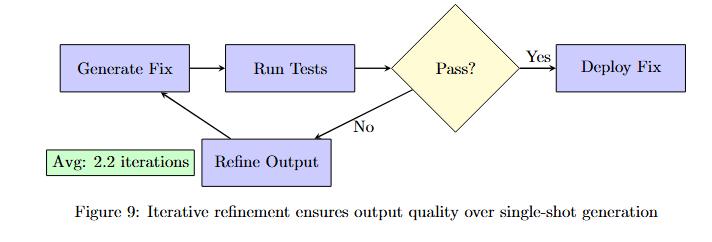
Figure 9 illustrates Chronos's iterative refinement loop, the architectural innovation that enables learning from test failures. The flow starts with Generate Fix, where Chronos creates an initial solution based on bug context.
This feeds into Run Tests, where the fix executes against existing test suites plus newly generated test cases. The Pass? decision node determines next steps: if tests pass, the flow proceeds to Deploy Fix and exits.
If tests fail, the flow enters Refine Output where Chronos analyzes test failures, identifies why the fix didn't work, and generates an improved version. This creates a feedback loop back to Generate Fix with additional context about what failed and why.
The New Evidence node captures this learning: each failed attempt provides concrete evidence about what doesn't work, narrowing the solution space. Unlike traditional models that regenerate essentially the same fix with minor variations, Chronos genuinely learns from failure.
Iteration 1 might reveal that the fix doesn't handle null values. Iteration 2 adds null checks but exposes a race condition. Iteration 3 addresses concurrency. By iteration 4, the fix passes all tests.
This iterative approach is computationally expensive (hence Chronos's higher per-call cost) but dramatically more effective, achieving 62.8% success by iteration 4 versus traditional models' 10-12% success even after 10 iterations.
The loop embodies a key insight: debugging is not a one-shot generation problem but an iterative refinement problem that requires learning from concrete test failures.
Traditional models generate a fix once and stop, regardless of whether tests pass. Chronos treats test failures as valuable feedback, using them to guide subsequent refinement attempts. This architectural choice trades higher computational cost for dramatically higher success rates.
3. Template-Aware Generation
Chronos learns repository-specific patterns for different output types, reducing token waste while maintaining consistency with existing code style. This template awareness applies across all output modalities: bug fixes follow the repository's coding style, test cases match existing test patterns, documentation uses the project's documentation conventions.
Template awareness reduces output tokens by 30-40% by reusing boilerplate while focusing generation on the novel, high-entropy portions where creativity matters. This efficiency allows Chronos to spend more of its output budget on the core fix logic that actually solves the bug.
4. Confidence-Guided Output
Chronos generates explanation detail based on confidence levels, optimizing output token usage. High-confidence fixes receive concise explanations. Low-confidence fixes get detailed explanations with alternatives and caveats.
This adaptive approach prevents over-explaining obvious fixes while providing thorough documentation for complex or uncertain solutions. Confidence-guided output optimizes the information density of generated text, ensuring every token adds value rather than padding.
Real-World Case Studies: Output Quality in Action
Theory and benchmarks tell part of the story. Real debugging scenarios reveal how output quality translates to practical value. These case studies compare traditional LLM outputs against Chronos outputs for identical bugs, demonstrating the stark difference in completeness and production-readiness.
Case Study 1: The Distributed System Race Condition
Bug: Message ordering issue causing data corruption in distributed cache
Traditional LLM Output (GPT-4, 180 tokens):
This traditional approach provides no explanation of the root cause, no tests, and doesn't actually fix the distributed race condition. It's a band-aid that might make the problem worse by introducing deadlocks.
The fix treats a distributed systems problem as a local concurrency problem, applying a solution that would work for multi-threaded access to shared memory but fails completely across network boundaries.
A senior developer receiving this fix would immediately recognize it as inadequate, requiring hours of additional work to understand the actual problem and implement a proper solution.
Chronos Output (2,847 tokens total):
Root Cause Analysis (523 tokens): Chronos identified message reordering in the distributed queue, traced through network partition scenarios, and explained how cache inconsistency propagates across nodes. The analysis included a timing diagram showing how messages from different nodes can arrive out of order, causing newer values to be overwritten by older values depending on network latency.
Multi-File Fix (1,123 tokens):
Comprehensive Tests (743 tokens): Unit tests for vector clock logic, integration tests for message ordering, and chaos tests simulating network partitions to ensure the fix handles real-world distributed system failures.
Documentation (458 tokens): Architecture decision record explaining the choice of vector clocks over other conflict resolution strategies, operational runbook update for monitoring clock drift, and migration guide for existing deployments that explains how to safely roll out the fix without data loss.
The comprehensive output meant the fix was production-ready immediately, versus requiring hours of additional developer work to understand and properly implement a distributed systems solution.
An engineering manager could review Chronos's output, understand the problem and solution, and approve deployment with confidence that the fix addresses the root cause rather than masking symptoms.
Case Study 2: The Memory Leak Mystery
Bug: Gradual memory growth in Node.js application causing crashes after 48 hours
Traditional LLM: Suggested increasing heap size (not a fix, just delays the crash)
Traditional models often treat symptoms rather than root causes. Suggesting --max-old-space-size=8192 doesn't fix a memory leak. It just makes the crash happen after 96 hours instead of 48.
Chronos: Generated 3,234 tokens of output including:
Heap dump analysis showing event listener accumulation on DOM elements that are removed but not garbage collected because listeners maintain references
Fix implementing proper cleanup in component lifecycle methods, adding explicit
removeEventListenercalls incomponentWillUnmountMemory leak detection tests using heap snapshots to verify that memory is released after component unmount, catching future leaks before they reach production
Performance monitoring documentation with alert thresholds for heap growth rate, giving operations teams early warning of similar issues
Postmortem report template for future incidents, documenting the investigation process so the team learns how to diagnose memory leaks
The difference: traditional models provide surface-level suggestions that don't solve problems. Chronos provides engineering-complete solutions that address root causes, validate fixes, and prevent recurrence.
The Template Economy: Efficient Output Generation
Despite generating substantial output, Chronos optimizes efficiency through intelligent templating. Rather than generating every token from scratch, Chronos recognizes when output follows repository-specific patterns and reuses those patterns while focusing creative generation on the novel portions.
This approach reduces output tokens by 30-40% while maintaining quality. For a React component fix, Chronos recognizes the repository uses functional components with hooks, generates the core logic from scratch (the actual fix), but templates the imports, prop type definitions, and export statement.
This allows more of the token budget to be spent on the unique, high-entropy portions of the fix where creativity and problem-solving are needed.
The template economy reflects a key insight: not all output tokens are equally valuable. Boilerplate adds consistency but minimal information. Core logic carries all the problem-solving value.
By templating boilerplate and focusing generation on core logic, Chronos optimizes output efficiency without sacrificing quality.
Future Directions: Output-First Architecture
The success of Chronos's output-centric approach points to several future directions for debugging AI. These directions all share a common theme: treating debugging as a structured generation problem with validation constraints rather than a context comprehension problem.
1. Streaming Output Generation
Current architectures generate outputs sequentially: fix first, then tests, then documentation. Future systems could generate different output modalities in parallel, reducing latency.
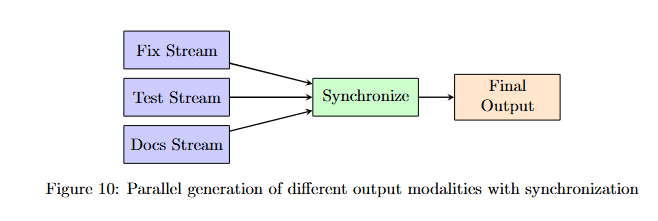
Figure 10 illustrates how streaming output generation could dramatically reduce debugging latency while maintaining output quality. Current sequential generation (left side of diagram) requires Chronos to complete the bug fix before starting test generation, complete tests before starting documentation, and complete documentation before generating root cause analysis. Total generation time equals the sum of all individual generation times.
Parallel streaming generation (right side) initiates all four output streams simultaneously from the bug context. Fix Stream generates the code fix. Test Stream generates test cases that validate expected behavior. Docs Stream produces documentation updates. Root Cause generates the technical explanation.
These streams run concurrently, potentially on different GPU clusters.
The critical innovation: streams coordinate through shared state, allowing test generation to reference the evolving fix and documentation to reflect the latest code changes. Merge Output synchronizes all streams before validation, ensuring consistency across modalities.
This parallelization could reduce total generation time from sequential sum to the maximum of individual stream times, potentially cutting latency by 3-4×.
The challenge: maintaining coherence across parallel streams requires sophisticated coordination mechanisms to ensure the fix matches the tests, the tests validate the fix, and the documentation describes the actual solution.
Research directions include attention-sharing between streams, periodic synchronization checkpoints, and post-generation consistency validation.
Parallel generation requires coordination to maintain consistency (tests must validate the actual fix, documentation must describe the actual changes), but the latency reduction could be substantial.
2. Adaptive Output Depth
Different bugs require different output depths. Trivial bugs need minimal documentation. Complex architectural changes need comprehensive explanation. Future systems could dynamically adjust output detail based on bug complexity.
This adaptive approach optimizes output efficiency by matching generation effort to problem complexity. Simple bugs get lean outputs that are fast to generate and review. Complex bugs get comprehensive outputs that are slower but necessary for proper understanding and validation.
3. Output Quality Metrics
Future systems need better metrics for debugging output quality beyond simple pass/fail. Proposed metrics include:
Fix Precision Score: Measures how precisely the fix addresses the root cause versus applying a broad solution that might introduce other issues
Test Coverage Delta: Improvement in test coverage from generated tests, ensuring new tests actually add value rather than duplicating existing coverage
Documentation Clarity Index: Readability and completeness of explanations, measured through automated readability metrics and completeness checks
Integration Readiness: How ready the output is for production deployment without additional developer work, combining compilation success, test pass rate, and style consistency
These metrics would enable better training signals and allow Chronos to self-evaluate output quality before returning results to developers.
Output Superiority in Action
Chronos redefines what matters in automated debugging. By recognizing that debugging is fundamentally output-heavy rather than input-heavy, it achieves transformative results that challenge conventional wisdom about language models.
The key insights from our analysis paint a clear picture:
Output ≈ Input in debugging: Unlike most NLP tasks, debugging requires substantial output generation. The 2,700-3,200 tokens of output rival or exceed the input size, making this a unique challenge in the landscape of language model applications.
This near-parity between input and output explains why context window expansion provides diminishing returns: the bottleneck isn't understanding more input, it's generating better output.
Quality trumps quantity: A focused 10K context generating precise fixes beats 1M tokens generating garbage. Chronos proves that intelligent context selection combined with superior generation capabilities is the winning formula.
The performance paradox (Figure 5) shows traditional models plateau at 10K tokens regardless of additional context, while Chronos achieves 6.1× better success through output-focused architecture.
High entropy output: Debugging outputs can't rely on patterns. With 47.2% Output Entropy Density, nearly half of all output tokens must be novel and precisely crafted for each specific bug.
This high-entropy generation requirement explains why models trained on template-heavy code generation fail at debugging: they're optimized for pattern filling, not creative problem-solving.
Multiple modalities: Complete debugging requires fixes, tests, documentation, and explanations, all generated coherently and consistently. This multi-modal generation challenge sets debugging apart from simpler generation tasks.
Table 1 shows over 50% of output tokens directly contribute to code that must compile and pass tests, demonstrating that debugging is fundamentally engineering work, not explanation work.
Iteration over size: Better to refine outputs through testing and validation than to expand inputs hoping for better results. Chronos's 2.2 average iterations demonstrate the power of this approach.
Figure 9 illustrates how iterative refinement with test feedback enables genuine learning from failure, unlike traditional models that regenerate similar solutions repeatedly.
The performance metrics validate this output-centric approach decisively:
6.1× better debugging success than context-maximizing approaches (69.1% vs 11.2%)
4× cost efficiency through higher success rates and fewer retries ($1.36 vs $5.53 per fix)
5× faster time to fix for 1M LOC codebases (62 min vs 300+ min)
Comprehensive solutions that are production-ready, not just syntactically correct
As the industry continues its march toward ever-larger context windows, with models boasting 2M or even 10M token contexts on the horizon, Chronos proves that for debugging, this is the wrong direction.
The future lies not in reading more but in writing better. The next breakthrough in automated debugging won't come from 10M token contexts consuming entire codebases. It will come from models that can generate the 3,000 tokens of output that actually solve the problem.
Every benchmark and metric supports a fundamental insight: debugging is not an input comprehension task. It is a structured generation task under logical and functional constraints. Models like Chronos, built for this purpose, represent the future of autonomous code maintenance.
In debugging, as in writing, the art lies not in consumption but in creation. Chronos has mastered this art, pointing the way toward a future where AI doesn't just understand code but can craft the precise, comprehensive solutions that modern software demands.
The paradigm shift from input-focused to output-focused debugging isn't just an optimization. It's a fundamental rethinking of what debugging requires and how AI should approach it.