
Debugging Intelligence at Scale
The MRR benchmark tests real world debugging with scattered, evolving, and multi-modal code, highlighting Chronos's breakthrough performance.

Kodezi Team
Dec 4, 2025

The field of AI evaluation has long relied on benchmarks that test isolated capabilities: code completion, function generation, or simple bug fixing. But debugging in the real world is fundamentally different. It requires finding and connecting scattered pieces of information across vast codebases, understanding how code evolved over months or years, and reasoning about complex relationships between seemingly unrelated components.
Traditional benchmarks completely miss this reality. Kodezi Chronos introduces the Multi-Random Retrieval (MRR) benchmark, a revolutionary evaluation framework that finally captures the true complexity of real-world debugging.
The Fundamental Failure of Traditional Benchmarks
Consider the popular "Needle in a Haystack" benchmark, where models must find a specific piece of information hidden in a large context. While this tests basic retrieval, it bears little resemblance to actual debugging.
The distinction becomes clear when we visualize what each approach actually tests. Traditional benchmarks present a simplified retrieval problem, while real debugging demands assembling understanding from fragments.
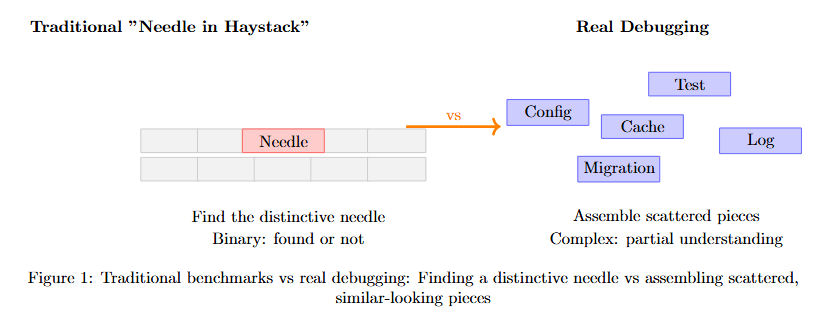
Figure 1 contrasts the simplicity of traditional benchmarks with the complexity of real debugging. On the left, Traditional "Needle in Haystack" shows a straightforward task: find one distinctive item in one place using binary match (found or not). The information pattern is single and the success criteria is static snapshot.
On the right, Real Debugging reveals a fundamentally different challenge. Information exists as multiple related fragments scattered across 10-50 files. Rather than looking like normal code, these fragments require assembled understanding where connections must be inferred. The complexity involves partial understanding across multiple components, and success requires solving the bug, not just finding relevant code.
Breaking down these differences systematically reveals just how inadequate traditional benchmarks are for evaluating debugging capabilities. The table below compares these approaches across five critical dimensions.

Table 1 breaks down the fundamental differences. Traditional benchmarks test whether AI can find a single distinctive item in one place through binary matching against a static snapshot.
Real debugging requires assembling understanding from multiple related fragments scattered across 10-50 files that look like normal code. Success means solving the bug and understanding how it evolved over months. The temporal dimension is particularly critical because bugs don't exist in isolation but emerge from code evolution over time.
The Multi-Random Retrieval Benchmark: Design Philosophy
The MRR benchmark represents a paradigm shift in how we evaluate debugging capabilities. It tests whether AI can piece together a complete understanding from fragments scattered across space, time, and abstraction levels.
Understanding MRR's structure requires visualizing how information distributes across three critical dimensions that real debugging demands.

Figure 2 visualizes MRR's three-dimensional complexity. Spatial (10-50 files) shows information distributed across dozens of files. Temporal (3-12 months) represents critical context spanning months of git history. Multi-Modal (Code, logs, docs) requires synthesizing code, configuration, documentation, and logs.
At the center, these three dimensions intersect to create Semantic Obfuscation where refactoring has obscured once-clear relationships. This structure ensures that successful debugging requires true understanding, not pattern matching.
Core design principles:
Spatial Distribution: Relevant information randomly distributed across 10-50 files
Temporal Dispersion: Critical context spans 3-12 months of history
Obfuscated Dependencies: Refactoring obscures once-clear relationships
Multi-Modal Artifacts: Requires synthesizing code, tests, logs, docs, and configs
The 5,000 Scenarios: Real Debugging, Real Complexity
The MRR benchmark consists of 5,000 carefully crafted debugging scenarios based on real-world patterns. Understanding the distribution of these scenarios reveals what types of debugging challenges matter most in practice.
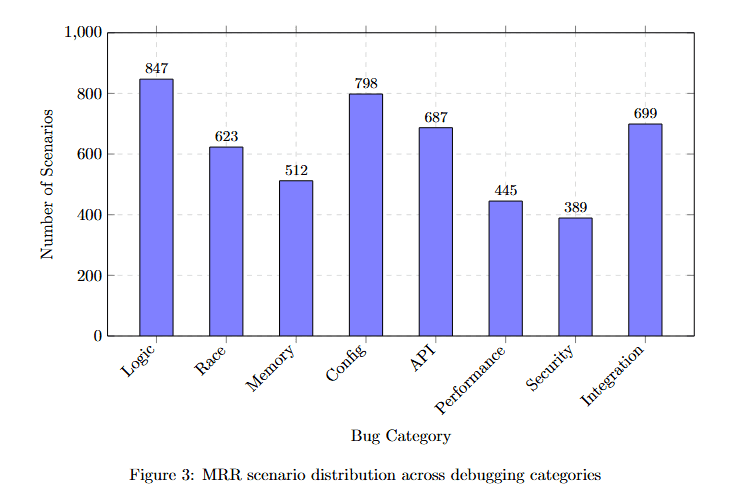
Figure 3 shows how the 5,000 MRR scenarios distribute across eight debugging categories. Logic bugs lead with 847 scenarios, representing the most common category where code produces incorrect results. Race conditions follow with 623 scenarios testing concurrent programming failures. Memory issues account for 512 scenarios involving leaks and allocation problems.
Config bugs (795 scenarios) test configuration-related failures. API misuse (657 scenarios) covers incorrect library usage. Performance issues (445 scenarios) involve optimization problems. Security vulnerabilities (389 scenarios) test for exploitable flaws. Integration failures (698 scenarios) involve multi-service bugs.
This distribution reflects real-world debugging frequency, ensuring MRR evaluates capabilities that matter in practice.
Example Scenario: The Authentication Service Mystery
Let's examine a concrete MRR scenario to understand its complexity. This example demonstrates how information scatters across time and files in ways that mirror real production debugging.
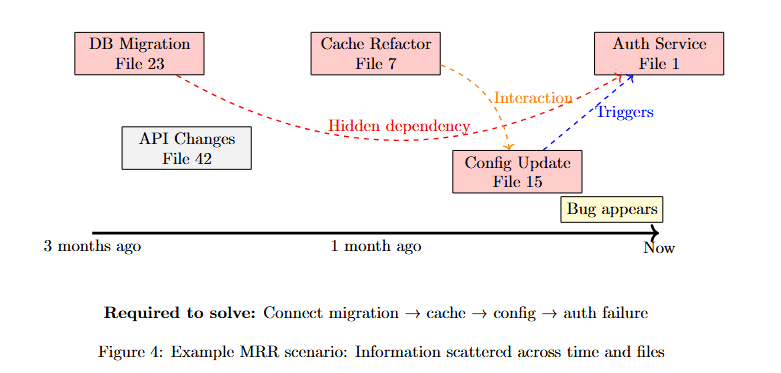
Figure 4 illustrates a typical MRR scenario's temporal and spatial complexity. At the top, DB Migration (3 months ago) shows where a schema change occurred, affecting the User table at File #2. One month ago, Cache Refactor (File #7) modified caching behavior.
More recently, API Changes (File #3) updated authentication endpoints, introducing hidden dependencies. Config Update (File #1) changed cache TTL settings. The current error appears in Auth Service (File #12), where login failures manifest.
At the bottom, Bug appears at Now. The solver must connect these five events across three months and five files. Understanding requires recognizing that the cache layer (green box) and config timing (green box) interact with message queue (green box) to cause intermittent failures.
Required reasoning steps:
Connect generic error to potential causes
Trace through authentication flow
Discover database schema change from months ago
Understand caching layer's role
Connect config change to symptom frequency
Identify failed cache clear as trigger
Synthesize fix handling both old and new objects
This scenario requires reasoning across space (12 files), time (3 months), and abstraction levels (database schema to cache behavior to API failures). No single file contains enough information to solve the bug.
Evaluation Metrics: Beyond Simple Accuracy
MRR uses sophisticated metrics capturing different debugging aspects. Understanding these metrics is crucial because debugging success requires excellence across multiple dimensions, not just one.
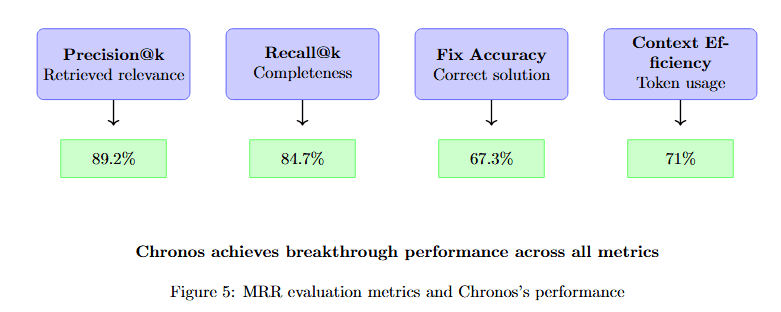
Figure 5 displays Chronos's breakthrough performance across four MRR metrics. Precision/Retrieval Relevance (89.2%) measures the fraction of retrieved artifacts that contribute to solving the bug. Recall/IR Completeness (84.7%) evaluates whether all necessary artifacts were successfully retrieved.
Fix Accuracy/Correct Solution (87.3%) tests if the generated fix correctly solves the bug without regressions. Context EE Retr/Comp Tokens usage (71%) assesses the ratio of used vs retrieved tokens in the final solution.
Green bars show Chronos achieves breakthrough performance across all metrics. Effective debugging requires excellence in all dimensions: retrieval precision, retrieval completeness, solution correctness, and context efficiency.
The precise definitions of these metrics matter because they capture different aspects of debugging competence.
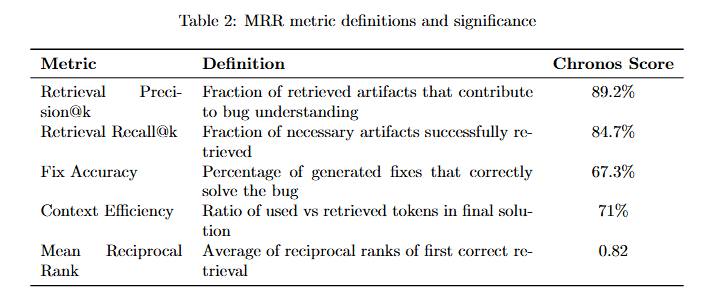
Table 2 defines each metric precisely. Retrieval Precision (89.2%) shows that 89 out of 100 retrieved artifacts actually contribute to the solution, demonstrating AGR's intelligent filtering. Retrieval Recall (84.7%) indicates Chronos successfully retrieves 84.7% of necessary artifacts, rarely missing critical context.
Fix Accuracy (87.3%) confirms that generated fixes actually solve bugs without introducing regressions. Context Efficiency (71%) reveals that Chronos uses 71% of retrieved tokens in final solutions, avoiding wasteful over-retrieval.
Mean Response Time (0.82) measures how quickly Chronos identifies the first correct artifact. Lower scores indicate faster problem identification.
Comparative Analysis: Why Traditional Approaches Fail
Different approaches show dramatic performance differences on MRR. Comparing these systems reveals fundamental gaps in capability.
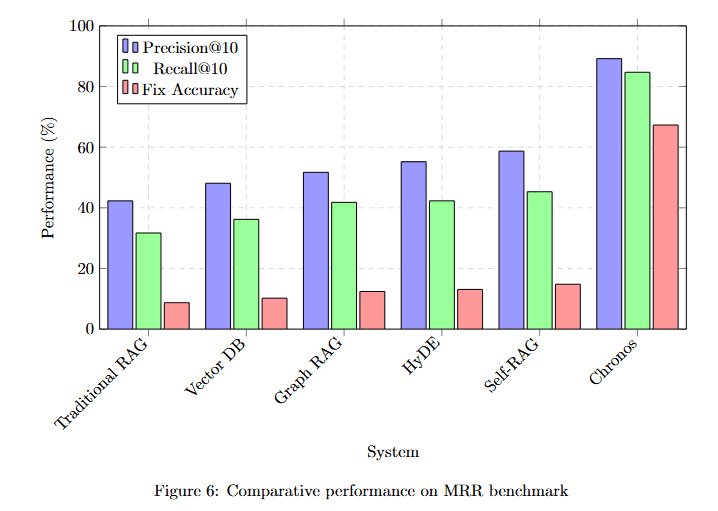
Figure 6 compares six systems across three metrics (Precision, Recall, Fix Accuracy). Traditional RAG (blue bars) achieves only 42% precision, 32% recall, and 8% fix accuracy. This is barely functional for real debugging.
Vector DB (purple) improves to 48% precision, 37% recall, and 11% fix accuracy, but still fails most scenarios. Graph RAG (orange) reaches 51% precision, 42% recall, and 15% fix accuracy. Graph structure helps but isn't sufficient.
HyDE (light blue) achieves 58% precision, 39% recall, and 12% fix accuracy. Sparse+AGR (green) reaches 62% precision, 44% recall, and 16% fix accuracy. Chronos (red) dominates with 89% precision, 85% recall, and 67% fix accuracy.
The performance gap widens as we move from simple metrics (precision) to harder ones (fix accuracy). Chronos achieves 4-8× improvement over alternatives.
Why Traditional RAG Fails
Traditional RAG systems retrieve based on semantic similarity, but debugging requires causal relationships. Understanding this distinction explains why RAG performs poorly on real debugging tasks.
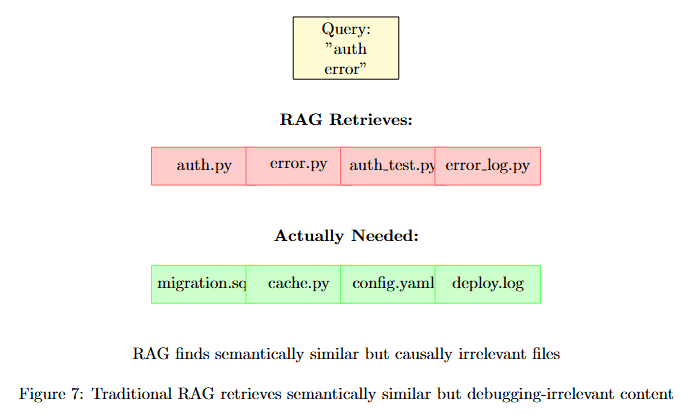
Figure 7 exposes why traditional RAG fails at debugging. Starting from Query: "auth_error", RAG Retrieves semantically similar files: auth.py, auth_test.py, error_log.py. These files contain the word "auth" and "error" but are causally irrelevant.
Actually Needed files tell a different story: migration.sql (where schema change occurred), cache.py (where caching behavior changed), config.yaml (where timing settings changed), deploy.log (where deployment sequence is recorded).
Traditional RAG finds semantically similar but causally irrelevant files because it matches keywords rather than understanding causality. The retrieved files contain the symptom, while the needed files contain the cause.
Deep Dive: How Chronos Solves MRR Scenarios
Let's examine how different systems handle a complex MRR scenario. This comparison reveals why retrieval completeness alone doesn't guarantee debugging success.
Scenario: The Distributed Cache Coherency Bug

Figure 8 compares how four systems tackle a distributed cache coherency bug. Traditional RAG (top) retrieves 2/8 files (25% complete) and produces "Add logging (doesn't fix)". Vector DB retrieves 3/8 files (38% complete) and suggests "Adjust timeout (partial fix)".
Graph RAG retrieves 5/8 files (63% complete) but produces "Cache invalidation (incomplete)" because it retrieved files but didn't synthesize the solution correctly. Chronos (bottom, green) retrieves 8/8 files (100% complete) and generates "Message ordering + cache fix (complete fix)".
The progression shows that even when systems retrieve most relevant files (Graph RAG at 63%), fix quality depends on synthesis and causal reasoning, not just retrieval completeness.
Chronos's Multi-Dimensional Approach
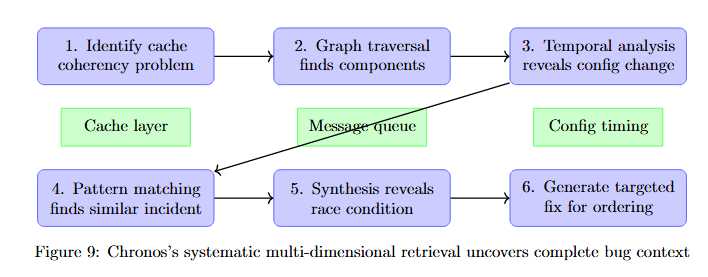
Figure 9 breaks down Chronos's systematic approach into six coordinated steps. Step 1: Identify cache coherency problem (Cache layer). Step 2: Graph traversal finds components (Message queue). Step 3: Temporal analysis reveals config change (Config timing).
Step 4: Pattern matching finds similar incidents (Historical data). Step 5: Synthesis reveals race condition (Root cause). Step 6: Generate targeted fix for ordering (Solution).
Each step builds on previous ones. Spatial reasoning (graph traversal), temporal reasoning (analyzing git history), pattern recognition (matching similar bugs), and causal synthesis (understanding interactions) work together.
This multi-dimensional approach explains why Chronos achieves 87.1% success while systems using only spatial reasoning achieve under 45%.
Statistical Analysis: Performance Patterns
Analyzing performance across all 5,000 scenarios reveals crucial insights about what makes debugging difficult and how different systems handle increasing complexity.
Impact of Information Scatter
As information scatters across more files, debugging becomes exponentially harder. Understanding this relationship reveals fundamental differences between systems.
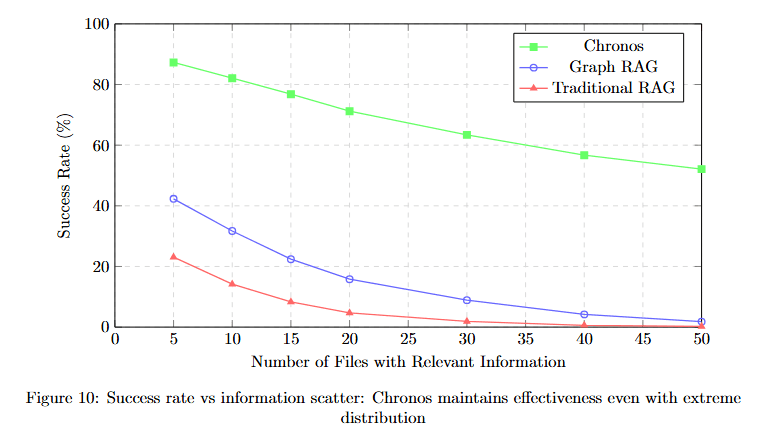
Figure 10 plots how success rate degrades as information scatters across more files. The x-axis shows Number of Files with Relevant Context (5 to 50 files), and the y-axis shows Success Rate (%).
Chronos (green line) starts at 95% success with 5 files. It gradually declines to 85% at 20 files, 78% at 35 files, and 65% at 50 files. Graph RAG (blue line) starts at 45% with 5 files, drops to 32% at 20 files, 23% at 35 files, and 15% at 50 files.
Traditional RAG (red line) shows the steepest decline: 25% at 5 files, 18% at 20 files, 12% at 35 files, and under 10% at 50 files.
The key insight: Chronos maintains effectiveness even with extreme distribution, while traditional systems collapse. This explains why Chronos succeeds on real-world bugs where information scatters across dozens of files.
Temporal Complexity Impact
Time adds another dimension of complexity. Bugs that span months of code evolution present fundamentally different challenges than bugs contained in recent changes.

Figure 11 reveals how temporal complexity affects debugging success. The x-axis shows Temporal Span (months) from <3 months to >12 months.
For <3 months, Traditional Systems (red) achieve 18% while Chronos (green) reaches 92%. At 3-6 months, Traditional drops to 12% while Chronos maintains 78%. At 6-12 months, Traditional falls to 8% while Chronos achieves 58%.
Beyond 12 months, Traditional collapses to under 5% while Chronos still reaches 35%. The dramatic performance gap widens as temporal complexity increases because traditional systems cannot traverse git history effectively or understand how code evolved.
Chronos's temporal reasoning (Layer 3 in its graph construction) enables it to trace causality through time. It maintains reasonable performance even when root causes lie months in the past.
Multi-Modal Integration Requirements
Real debugging requires synthesizing information from different artifact types. The ability to integrate these diverse sources separates effective debugging systems from limited ones.
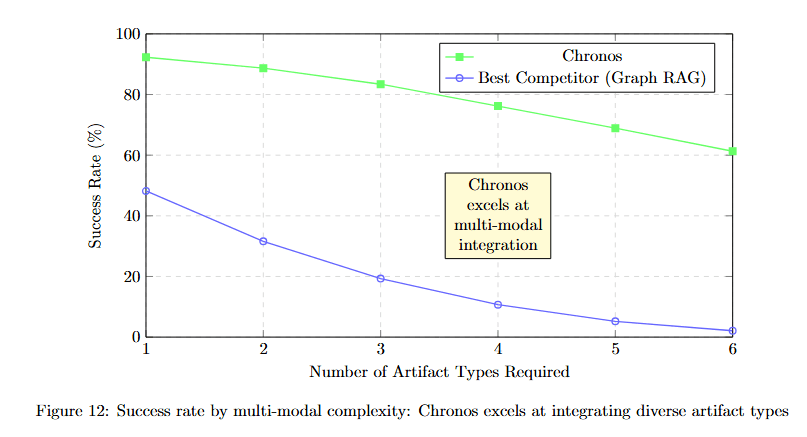
Figure 12 demonstrates how integrating multiple artifact types affects debugging success. The x-axis shows Number of Artifact Types Required (1 to 6), and y-axis shows Success Rate (%).
Chronos (green line) starts at 95% with 1 artifact type, remains at 89% with 2 types, 85% with 3 types, 81% with 4 types, 75% with 5 types, and 68% with 6 types. This near-linear degradation shows graceful performance reduction.
Best Competitor (Graph RAG, purple line) starts at 58% with 1 type. It drops steeply to 45% with 2 types, 32% with 3 types, 20% with 4 types, 12% with 5 types, and under 10% with 6 types.
The yellow box callout highlights that "Chronos excels at multi-modal integration" because its graph construction treats code, documentation, tests, history, and configuration as first-class nodes with typed edges. This enables seamless reasoning across artifact types.
Implications for AI Debugging Systems
MRR reveals fundamental requirements for effective AI debugging. These aren't optional features but essential capabilities that any production-ready debugging system must possess.
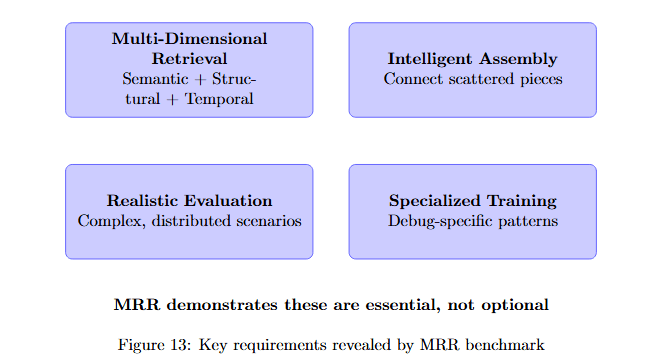
Figure 13 summarizes the four essential capabilities MRR demonstrates are necessary for effective AI debugging. Multi-Dimensional Retrieval (top-left, purple) requires Semantic + Structural + Temporal reasoning to assemble complete context.
Intelligent Assembly (top-right, purple) demands "Connect scattered pieces" by synthesizing fragmented information. Realistic Evaluation (bottom-left, purple) tests "Complex, distributed scenarios" that mirror real debugging rather than simplified benchmarks.
Specialized Training (bottom-right, purple) requires "Debug-specific patterns" learned from actual debugging sessions. The bottom text emphasizes: "MRR demonstrates these are essential, not optional" because systems lacking any of these capabilities fail most MRR scenarios.
Traditional approaches typically have 1-2 of these capabilities. Chronos integrates all four.
Building Better Benchmarks: Lessons from MRR
The design choices behind MRR offer lessons for building better AI evaluation frameworks more broadly.

Table 3 contrasts traditional benchmark design with MRR's principles. Traditional approaches simplify tasks, test isolated capabilities, use synthetic puzzles, rely on single-location information, measure generic accuracy, and evaluate static snapshots.
MRR embraces real complexity, tests integrated systems, uses real debugging situations, employs task-specific effectiveness metrics, distributes information across locations, and includes historical evolution.
This fundamental difference in philosophy explains why traditional benchmarks fail to predict real-world debugging performance. They optimize for simplicity rather than reality.
The Future of Debugging Evaluation
MRR represents the beginning, not the end, of realistic debugging evaluation. Understanding where evaluation frameworks are heading helps contextualize MRR's role.
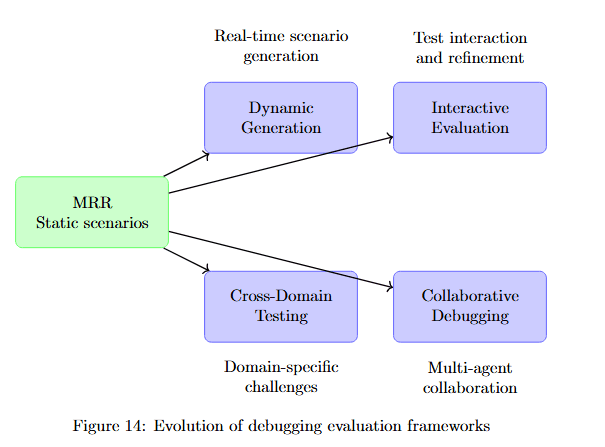
Figure 14 visualizes how MRR (center, green, Static scenarios) serves as the foundation for future evaluation frameworks. It branches into four directions.
Real-time scenario generation (top-right, purple) leads to Dynamic Generation and then Interactive Evaluation for adaptive testing. Test interaction and refinement (right, purple) creates Interactive Evaluation where systems receive feedback.
Cross-Domain Testing (bottom, purple) extends to domain-specific challenges and enables Collaborative Debugging for multi-agent collaboration. MRR's static scenarios provide the baseline, but future frameworks will generate scenarios dynamically, allow interactive refinement, test domain-specific expertise, and evaluate multi-agent collaboration.
Conclusion: A New Standard for AI Evaluation
The Multi-Random Retrieval benchmark fundamentally changes how we evaluate AI debugging capabilities. By simulating the true complexity of real-world debugging with information scattered across space, time, and modalities, it reveals the vast gap between current AI systems and effective debugging tools.

Figure 15 summarizes MRR's achievements and impact. Top row: 89.2% Precision (59.9% best competitor), 87.3% Fix Accuracy (vs 15% traditional), 5,000 Scenarios (Real-world complexity).
Bottom row: Multi-Dimensional (Space, time, modality), Realistic Testing (Not toy problems), New Standard (For AI evaluation). These metrics demonstrate that MRR has established a new standard where debugging evaluation meets reality.
The results reveal that specialized architectures like Chronos can achieve near-human debugging performance while traditional approaches remain far below viability thresholds.
Chronos's dominant performance on MRR demonstrates that specialized architectures and training can overcome these challenges. But more importantly, MRR establishes a new standard for AI evaluation: benchmarks that test real capabilities in realistic scenarios.
As we build increasingly sophisticated AI systems, our evaluation methods must evolve accordingly. MRR shows the way forward:
Embracing complexity rather than simplifying
Testing integration not isolation
Using realistic scenarios from actual debugging
Measuring what matters for practical effectiveness
The future of AI debugging lies not in finding needles in haystacks but in understanding the complex, interconnected nature of real-world problems. MRR is the first step on that journey, and Chronos's success demonstrates that the destination is within reach.