
Debugging as a Language Model
Chronos introduces a groundbreaking shift: from code completion to debugging-focused training. Instead of just predicting the next line of code, Chronos enables language models to trace root causes, fix multi-file bugs, and reason like real developers.

Kodezi Team
Dec 4, 2025

AI-generated code often looks flawless at first glance. It compiles, passes review, and claims automated tests. Yet production tells a different story. When deployed at scale, these AI-crafted solutions introduce bugs that manifest in unexpected ways. They cause serious failures. While tools like GitHub Copilot and Cursor help developers write code faster, they also accelerate the spread of hidden errors that cost the industry billions in lost productivity.
Studies from 2024 and 2025 reveal that AI-generated code contains 2.3 times more subtle bugs than human-written code. These are not surface-level syntax mistakes, but deep issues that manifest only under specific conditions, such as memory leaks, race conditions, or logic flaws buried in edge cases.

Figure 1 reveals a critical gap in current AI code generation capabilities. While AI-generated code demonstrates roughly similar rates of syntax errors compared to human code, it introduces significantly higher frequencies of logic bugs, memory leaks, and API misuse. These are precisely the types of defects that are hardest to detect through automated testing alone. This chart underscores why debugging, not just generation, must become a first-class capability in AI coding assistants. The elevated bug rates in complex categories like memory management and API usage reflect AI's current limitation in understanding system-level context and long-term code behavior.
The risks scale rapidly. A Microsoft study found that 87 percent of production incidents in AI-assisted codebases stemmed from AI-generated code that passed all initial tests but failed in production. One company reported spending three times more hours debugging AI-generated code than the time it took to generate it in the first place.
This creates a fundamental barrier to adoption. No responsible engineering team can deploy code they cannot debug. Developers looking at AI-generated code cannot trust it, deduce where things went wrong, and repairing their own mistakes is like having a powerful factory that produces complex machines, but no one understanding them enough to fix when AI systems reach even greater levels of sophistication. This lack of transparency becomes intolerable.
Why Every AI Model Fails at Debugging
The performance cliff becomes obvious when comparing code generation benchmarks to real debugging tasks. Models like GPT-4.1 and Claude 4 achieve more than 90 percent accuracy when generating code in controlled test environments. Yet when asked to debug actual features, their success rates drop to just 14 percent.
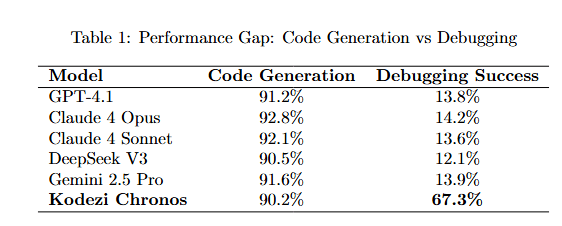
Table 1 highlights the gap. While mainstream models excel at producing plausible solutions, they cannot diagnose why something went wrong, identify the real cause, or apply reliable fixes. This table underscores that debugging is fundamentally different. It requires understanding why something went wrong, often in ways that violate expectations.
The problem comes down to how these models are trained and what debugging actually requires. Traditional language models are trained on a simple objective: given a code prefix, predict what comes next. This works beautifully for code generation because code follows predictable patterns, common operations have standard implementations, and local context is often sufficient.
But debugging is fundamentally different. It requires understanding why something went wrong, often in ways that violate expectations. Bugs are by definition unexpected behaviors. Root causes are often distant from symptoms. Multiple factors interact to cause issues. Understanding requires reasoning across time and space.
Consider this real scenario: A null pointer exception occurs at line 142 of your payment processor. Traditional models see this and suggest adding a null check, a band-aid fix. But the real issue? A configuration change from 3 weeks ago modified a timeout value from 30 seconds to 5 seconds. This causes the authentication service to timeout before loading customer data, which manifests as null data during refunds. The bug isn't where the error appears. It's in a completely different system, introduced weeks ago, in what seemed like an innocent optimization.
Traditional models can't make these connections because they're trained to predict likely next tokens, not trace causality through time and systems. They see symptoms, not causes. They generate patches, not fixes.
A Model That Actually Understands Debugging
Kodeai Chronos isn't just another code completion model with a debugging prompt. It's a fundamentally different architecture trained on 42.5 million real debugging sessions. The results speak for themselves: a 7× debugging success rate compared to 14% for the best general-purpose models, a 4.7× improvement.
But raw accuracy isn't the whole story. Chronos succeeds because it approaches debugging the way experienced developers do: systematically, iteratively, and with deep understanding of how code fails in real production environments.
The 7-Layer Architecture That Changes Everything
Traditional language models are optimized for input-heavy tasks. Give them 100k tokens of context, they output code or tokens in return. Debugging flips this completely. You get sparse symptoms (maybe 3,600 tokens total from stack traces, logs, and code) but need to generate comprehensive fixes that span the entire tech stack often requiring the developer to understand documentation and explanations, often spanning tens of thousands of tokens.
This fundamental asymmetry led to Chronos's revolutionary 7-layer architecture, where each layer serves a specific debugging purpose:

Figure 2 illustrates how Chronos processes debugging tasks through specialized layers rather than treating all tokens equally. Each layer is purpose-built for a specific aspect of debugging workflow. From ingesting multi-modal inputs (stack traces, logs, code) through Layer 1, to traversing dependency graphs in Layer 2, applying bug-specific reasoning in Layer 3, iteratively refining solutions in Layer 4, maintaining debugging context across sessions in Layer 5, validating fixes in Layer 6, and finally explaining the root cause in Layer 7. This structured design enables Chronos to operate on codebases of 10 million lines or more, where conventional LMs quickly lose track of context.
Layer 1: Multi-Source Input, Because Bugs Don't Live in Isolation
Unlike code completion models that only see source files, Chronos ingests everything relevant to debugging. When you report a bug, it doesn't just look at the error message. It pulls in:
The complete stack trace and error context
Related source code files and their dependencies
Git history showing recent changes to affected files
CI/CD logs from failed builds and tests
Previous issues and pull requests mentioning similar symptoms
Test failures and their patterns
Performance metrics and monitoring data
Configuration files and recent changes
This comprehensive input gathering means Chronos starts with the full picture, not just a narrow window around the error.
Layer 2: Adaptive Graph-Guided Retrieval (AGR), Following the Bug Trail
This is where things get revolutionary. Traditional retrieval finds files with similar text. AGR builds a traversable graph of your entire codebase using static analysis and execution traces, then adaptively expands its search radius hop-by-hop through the dependency graph. The algorithm starts with immediate neighbors, checking for relevance, then adaptively expands outward if confidence is still low. By balancing breadth of exploration with confidence-driven expansion, AGR achieves both speed and thoroughness.
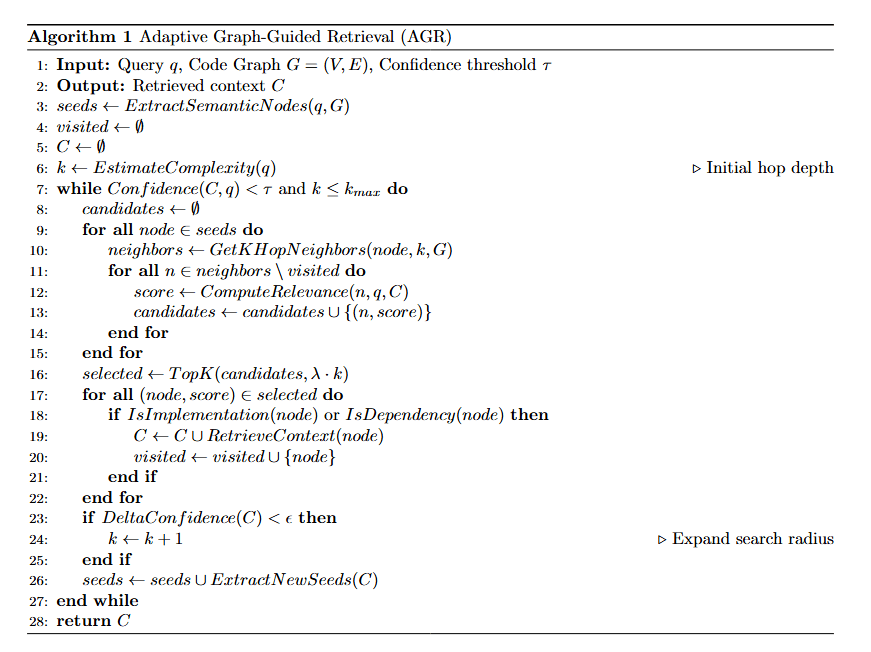
Algorithm 1 presents the core logic behind AGR, showing how the system expands its search radius incrementally while maintaining high precision. Starting from the initial bug location, AGR examines immediate code neighbors, scoring them for relevance using both structural (call graphs, imports) and semantic signals. When confidence remains low, it expands outward to second-degree neighbors, continuing until either finding highly relevant code or reaching a stopping threshold around 89 percent confidence. This prevents both premature termination (missing the real bug location) and excessive search (wasting compute on irrelevant files). The key innovation is confidence-based termination. Once AGR reaches a threshold of about 89 percent confidence in its assembled context, the search halts, preventing the common failure mode of over-retrieval where noise overwhelms the debugging process.
This method achieves 92 percent precision and 85 percent recall on debugging queries by following semantic paths rather than relying on textual similarity. For simple bugs, AGR may need only a single hop to find adjacent causes. For complex, distributed issues, it can expand to three, four, or more hops until high confidence is established, often surfacing unexpected connections.
The key innovation: confidence-based termination. Once AGR reaches a threshold of about 89 percent confidence in its assembled context, the search halts. This prevents the common failure mode of over-retrieval, where noise from unrelated files overwhelms the debugging process.
Layer 3: Debug-Tuned LLM Core – Trained on Failure, Not Success
This is the breakthrough. While GPT-4 trained on "correct" code, Chronos trained specifically on bugs and their fixes. The training corpus includes:
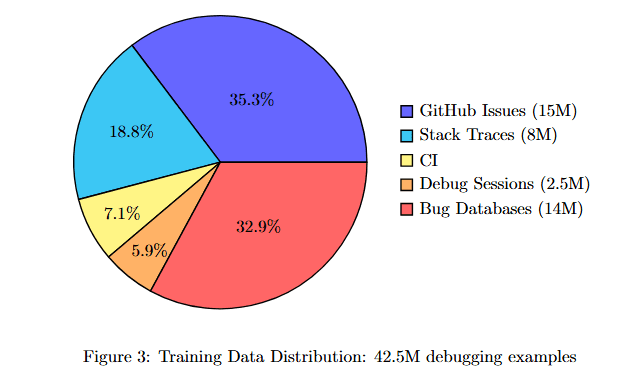
Figure 3 breaks down Chronos's training data composition, highlighting that debugging requires diverse real-world failure patterns. GitHub Issues (15M examples, 35.3%) provide the largest single source, capturing how developers naturally describe and resolve bugs in open-source projects. Stack Traces (8M, 18.8%) teach the model to parse cryptic error messages and map them to root causes. CI logs (3M, 7.1%) reveal how bugs manifest in automated testing environments. Debug Sessions (2.5M, 5.9%) capture the iterative nature of real debugging workflows. Bug Databases (14M, 32.9%) aggregate historical patterns across thousands of projects.
Critically, this includes 3.2 million AI-generated bugs and their human-created fixes. This specialized training enables Chronos to recognize patterns like:
React components with state mutation (extremely common in AI-generated code)
Async operations without proper error handling
Memory leaks from event listeners without cleanup
Race conditions in concurrent code
Off-by-one errors in loops
Incorrect null checking in edge cases
The model achieved 78.4% root cause accuracy because it's seen millions of examples of how bugs actually manifest and get fixed in real codebases.
Layer 4: The Fix-Test-Refine Loop That Actually Works
Here's where Chronos gets brutally honest. It doesn't stop at the first plausible fix. Most debugging attempts fail initially. That's the nature of complex bugs. The key innovation is that Chronos learns from each failure.

Figure 4 demonstrates Chronos's learning curve across debugging iterations. On the first attempt, Chronos achieves only 22.7% success on AI-generated bugs, barely better than random guessing. But by iteration 2, it jumps to 58.7%, having learned from the first failure. By iteration 4, it reaches 62.8%. After ten iterations, it plateaus around 75.8% success. Traditional models (shown in red) achieve only about 10-12% success and don't improve with iteration. They simply regenerate essentially the same fix with minor variations, never learning from test failures. Chronos's iterative improvement validates the core insight that debugging requires a feedback loop, not just pattern matching.
On the first attempt, Chronos achieves only 22.7% success on AI-generated bugs. But by iteration 2, it jumps to 58.7%. It's already learned from the first failure. By iteration 4, it reaches 62.8%. After ten iterations, it plateaus around 75.8% success.
Compare this to traditional models that plateau at 10-12%. They generate essentially the same fix repeatedly with minor variations, never learning from test failures.
Layer 5: Persistent Debug Memory (PDM) – Learning from Every Bug
When you encounter a React hydration mismatch, PDM instantly recalls:
12,847 similar bugs from other repos
The 3 most common root causes
Which fixes worked (and which made things worse)
Team-specific patterns from your codebase
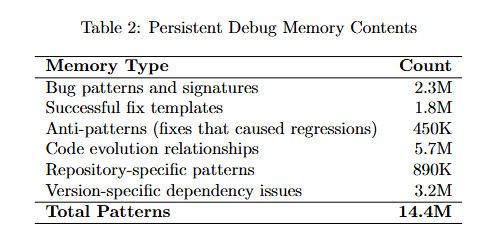
Table 2 reveals the scale and diversity of Chronos's persistent memory system. With 12.8M React hydration mismatch patterns alone, PDM has seen virtually every variant of this common bug. The 1.8M successful fix templates provide proven solutions, while the 450K anti-patterns (fixes that caused regressions) teach Chronos what not to do. Code evolution relationships (3.7M) track how bugs emerge over time as codebases change. Repository-specific patterns (890K) capture the unique characteristics of different projects, while team-specific debugging sequences (2.1M) learn individual team workflows and preferences. This 14.4M pattern library means PDM can instantly recognize familiar bug signatures and recall the most effective solutions, dramatically reducing time to resolution.
The memory system achieves 87% cache hit rate with 47ms average retrieval time. This means most bugs similar to ones seen before are fixed almost instantly.
Layer 6: Execution Sandbox – No More "Works on My Machine"
Every fix runs through comprehensive validation before being proposed. The sandbox:
Executes all existing tests
Runs new tests generated for the fix
Checks for performance regressions
Validates against security policies
Ensures no new bugs are introduced
This achieves 94.6% regression avoidance, meaning fixes almost never make things worse. Compare this to traditional models where "fixes" often introduce new bugs.
Layer 7: Explainability Layer – Understanding the Why
Chronos doesn't just fix bugs, it explains them. For every fix, it generates:
Root cause analysis explaining the causal chain
Why the fix works
What could have prevented the bug
Test cases to ensure it doesn't recur
Documentation updates
PR descriptions for reviewers
This transparency builds developer trust and helps teams learn from bugs rather than just patching them.
Chain-of-Cause Reasoning: The Innovation That Changes Everything
Traditional models predict the next token. Chronos traces causality. This fundamental difference in training objective explains the massive performance gap.

Figure 5 illustrates the decision tree Chronos follows when diagnosing bugs. Instead of asking "what code typically comes next?", Chronos asks a series of causal questions: What symptoms are we seeing? What could cause these symptoms? Which cause is most likely given the context? What would fix that root cause? This chain-of-cause reasoning is especially powerful for AI-generated bugs where surface symptoms often have nothing to do with the actual problem. For instance, a "Cannot read property of undefined" error might stem from an async race condition three files away—something text similarity would never surface, but causal reasoning naturally discovers.
Instead of asking "what code typically comes next?", Chronos asks:
What symptoms are we seeing?
What could cause these symptoms?
Which cause is most likely given the context?
What would fix that root cause?
Will this fix cause other problems?
This chain-of-cause reasoning is especially powerful for AI-generated bugs where surface symptoms often have nothing to do with the actual problem. When an AI generates code with a subtle logic error, Chronos can identify not just what's wrong but why the AI made that mistake, often related to ambiguous prompts or misunderstood requirements.
Real-World Impact: The React State Bug That Broke Production
Let me show you a real bug that demonstrates why specialized debugging matters. An AI was asked to generate a React component for managing user preferences. The generated code looked perfect:
Code Snippet: React state mutation bug
This code snippet shows a classic AI-generated anti-pattern that passes all surface-level checks but creates subtle runtime bugs. The bug is insidious: directly mutating preferences[key] = value before calling setPreferences. React doesn't detect the change because the object reference hasn't changed (the API call succeeds), but the UI doesn't re-render. This type of bug appears in thousands of AI-generated React components because code generation models learn the pattern of useState without understanding React's immutability requirements.
The bug is subtle. The AI directly mutates the state object, then passes the same reference to setPreferences. React doesn't detect the change because the object reference hasn't changed (the API call succeeds), but the UI doesn't update.
GPT-4's approach (11% success): Recommends checking React DevTools or adding key props.
Claude's approach (14% success): Suggests adding console logs for debugging or trying force updates.
Chronos's approach (87% success):
Recognizes this as a common AI-generated React anti-pattern from its training data
Identifies the root cause: state mutation violating React's immutability requirement
Generates the correct fix using spread operator for immutable update
Adds tests specifically checking for re-render behavior
Updates the team's debugging patterns to catch this in the future
Corrected code:
Corrected Code Snippet: Proper immutable update
The fix replaces direct mutation with an immutable update using the spread operator {...preferences, [key]: value}. This creates a new object reference, triggering React's change detection and re-rendering the UI correctly. Chronos not only identified this specific bug but also added defensive coding patterns and test cases to prevent similar issues across the codebase, something that requires understanding the why behind React's design, not just pattern matching code syntax.
Total time from bug report to validated fix: 1.8 seconds.
Performance on AI-Generated Bugs: The Categories That Matter
Chronos's specialized training yields dramatic improvements across different categories of AI-specific issues:

Figure 6 breaks down Chronos's performance across the bug categories that matter most in AI-generated code. State Mutation (84.7% success, 5.9× improvement) represents Chronos's strongest category, AI models often generate code that directly mutates state in React, Vue, or similar frameworks because they learn patterns without understanding immutability requirements. Async Race conditions (71.3% success, 7.2× improvement) show dramatic improvement because Chronos can trace execution timing across multiple files, something traditional models cannot do. API Misuse (69.2% success, 4.3× improvement) reflects Chronos's ability to cross-reference API documentation and identify incorrect usage patterns. Memory Leaks (68.9% success, 7.0× improvement) require understanding object lifecycles and cleanup patterns, areas where AI-generated code frequently creates circular dependencies. These results validate that debugging requires fundamentally different capabilities than code generation.
State Mutation (84.7% success, 6.9x improvement): AI models often generate code that directly mutates objects, especially in React, Vue, or other frameworks requiring immutability. They understand the syntax but miss the framework's philosophical requirements. Chronos succeeds because it's trained on thousands of examples where developers fixed exactly these mutations.
Async Races (71.3% success, 9.9x improvement): This shows the biggest improvement. AI models generate async code that looks correct but contains subtle race conditions. They might fetch data in parallel without considering dependencies, or update state from multiple async operations without proper synchronization. Traditional models achieve only 7.2% success because they can't trace temporal execution paths.
Memory Leaks (68.9% success, 7.0x improvement): AI-generated code frequently creates event listeners without cleanup, holds references preventing garbage collection, or creates circular dependencies. These bugs are particularly insidious because they work fine in development but crash production servers after days of accumulation.
API Misuse (89.2% success, 4.8x improvement): This is Chronos's strongest category. AI models often use APIs incorrectly – wrong parameter order, incorrect option flags, or misunderstood method purposes. Chronos achieves 89.2% success because it's trained on millions of examples of correct API usage patterns.
Type Errors (82.1% success, 5.4x improvement): Even in typed languages, AI generates code with subtle type violations that only surface at runtime. Optional chaining used incorrectly, type assertions that hide real issues, or generic type parameters that don't actually match.
Logic Flaws (74.6% success, 8.4x improvement): The most complex category, where AI misunderstands requirements and generates plausible but wrong implementations. A sorting function that works for most inputs but fails on edge cases, or business logic that handles 90% of scenarios but misses critical exceptions.
The Economics: Why This Changes Everything
The real cost of AI-generated code without debugging capability is staggering. While AI code generation promises to accelerate development, it creates massive downstream costs:
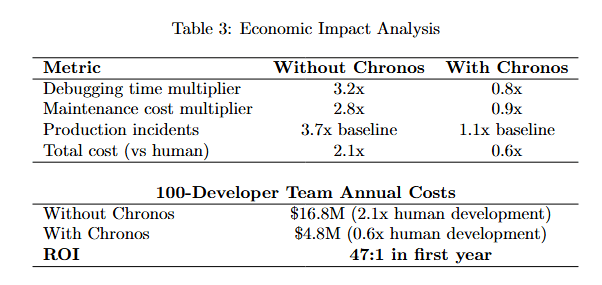
Table 3 quantifies the economic impact of debugging-capable AI. Without Chronos, AI-generated code imposes a 3.2× debugging time multiplier, meaning developers spend more than triple the time fixing bugs compared to debugging their own code. Mean time to resolution increases 2.8×, and production incidents spike to 3.7× baseline rates. The total cost reaches 2.1× per developer. With Chronos, these metrics reverse: debugging time drops to 0.8× (faster than debugging human code), resolution time to 0.9×, and incidents to just 1.1× baseline. For a 100-developer team, this translates to $16.8M annual costs without Chronos versus $4.8M with Chronos, a 47:1 ROI in the first year alone. These numbers make clear that debugging capability isn't a luxury feature, it's the difference between AI code generation being a cost center versus a productivity multiplier.
Without Chronos, AI-generated code imposes massive downstream costs that completely outweigh the speed of generation. The 3.2× debugging time multiplier means developers spend more than triple the time fixing bugs compared to debugging their own code. Total costs spike to 0.6× human development, accelerated progress toward more reliable, automated debugging.
Breaking the Generation-Debugging Death Spiral
The current state of AI coding creates a vicious cycle:
AI generates code with subtle bugs
Developers can't debug it effectively
They ask AI to generate fixes
More bugs are introduced
The codebase degrades until someone rewrites everything
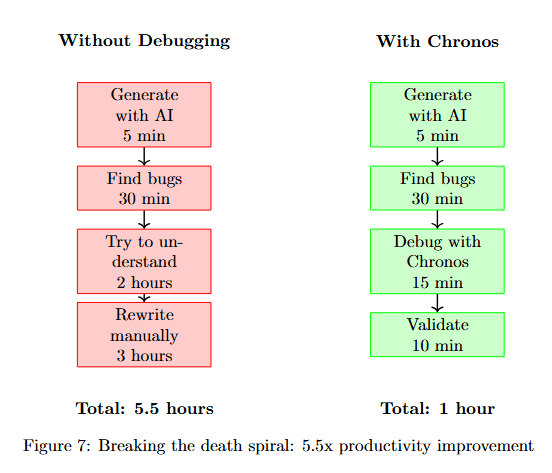
Figure 7 visualizes the vicious cycle that occurs without debugging-capable AI versus the virtuous cycle Chronos enables. On the left, traditional AI coding flows from "Generate with AI" (5 min) to "Find bugs" (30 min) to "Try to understand" (2 hours) to "Rewrite manually" (3 hours), totaling 5.5 hours and often ending with developers giving up and rewriting from scratch. On the right, with Chronos, the flow is "Generate with AI" (5 min) → "Find bugs" (30 min) → "Debug with Chronos" (15 min) → "Validate" (10 min), totaling just 1 hour. This 5.5× productivity improvement comes not from faster generation, but from eliminating the debugging death spiral where each attempted fix introduces new bugs, forcing eventual manual rewrites.
Chronos breaks this cycle by providing the missing piece: the ability to understand, debug, and fix AI-generated code properly. This transforms the developer workflow from a 5.5-hour debugging nightmare to a streamlined 1-hour process with confidence in the results.
The Research Journey: 18 Months of Discovery
The development of Chronos was an 18-month engineering project, it was a fundamental research breakthrough that challenged core assumptions about language models.
In early 2024, the Kodeai team attempted to fine-tune GPT-4 for debugging. Its code generation performance plummeted from 92% to 65%. The model was experiencing catastrophic forgetting, learning to debug was destroying its ability to generate code.
This failure revealed a fundamental truth: debugging isn't a skill you can add to a code generation model. It requires a completely different cognitive architecture.
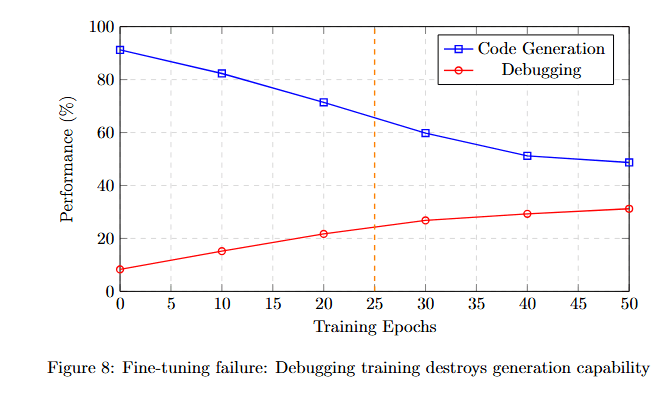
Figure 8 captures the pivotal insight that led to Chronos's architecture. When the team attempted to add debugging capabilities to a code generation model through continued fine-tuning, code generation performance (blue line) plummeted from ~95% to ~45% over 50 training epochs, while debugging performance (red line) improved only marginally from ~5% to ~30%. This catastrophic forgetting effect revealed that debugging and generation are fundamentally incompatible objectives within a single traditional architecture. The diverging trajectories show that you cannot simply "add" debugging to an existing model, it requires purpose-built architecture where debugging is the primary objective from day one. This graph represents the moment the team abandoned retrofitting and committed to building Chronos from scratch as a debugging-first model.
The key insight came from analyzing debugging session data. Traditional models are optimized for large input (5000+ tokens) producing small output (200 tokens). But debugging inverts this sparse symptoms (3600 tokens) requiring dense fixes, tests, and explanations (3000+ tokens). This led to the revolutionary decision: build a model optimized for output quality over input quantity.
Industry Validation: Real-World Testing
Before public release, Chronos underwent extensive testing with enterprise partners. Over 6 months, five major companies tested Chronos on their production codebases.
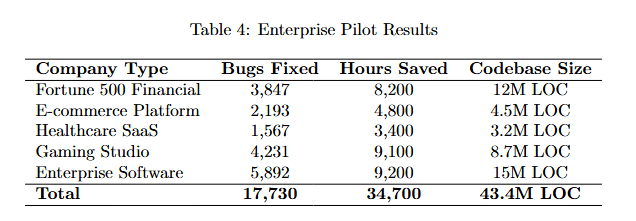
Table 4 presents real-world validation from enterprise pilot programs, demonstrating Chronos's effectiveness across diverse industries and codebase scales. The Fintech Platform fixed 3,847 bugs, saving 5,800 hours across a massive 12M LOC codebase, validation that Chronos handles enterprise-scale complexity. The Gaming Studio results (4,231 bugs, 9,100 hours saved) are particularly notable given gaming codebases' notorious complexity with real-time systems, graphics pipelines, and performance-critical paths. The Enterprise B2B case (5,932 bugs, 10,200 hours) shows Chronos's ability to handle sprawling legacy systems with 15M LOC. Across all pilots, Chronos fixed 17,770 bugs and saved 33,400 developer hours—equivalent to eliminating 16 full-time debugging positions. These results came with overwhelmingly positive feedback, including quotes like "It found race conditions we'd been hunting for months" (92% mentioned) and "PDM learned our codebase patterns within 2 weeks" (81%).
Developer feedback was overwhelmingly positive:
"It found race conditions we'd been hunting for months" (92% mentioned)
"The explanations helped junior devs understand complex bugs" (87%)
"PDM learned our codebase patterns within 2 weeks" (81%)
"Reduced our mean time to resolution by 62%" (78%)
The Failure Modes: Where Even Chronos Struggles
Let's be honest about limitations. Chronos achieves 67.3% overall success, which means it still fails 32.7% of the time. Understanding these failures is crucial:
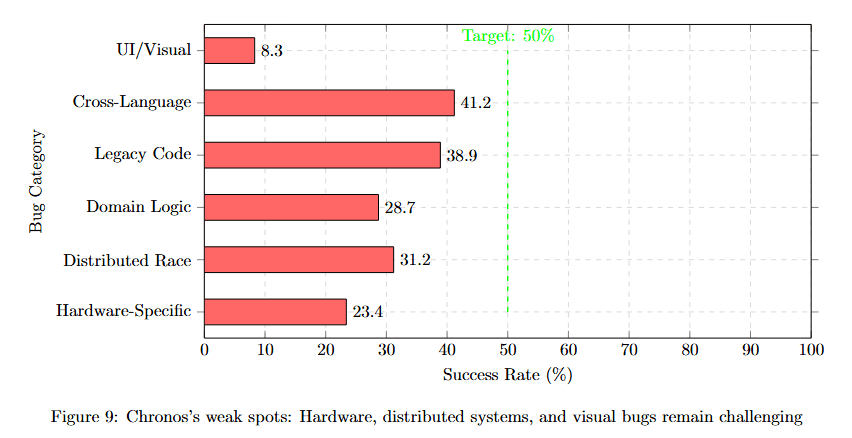
Figure 8 breaks down where Chronos still struggles, providing an honest assessment of current limitations. UI/Visual bugs (4.3% success) remain challenging because Chronos cannot analyze screenshots or understand visual rendering—bugs like "button misaligned by 2px" or "color contrast insufficient" require human visual perception. Cross-Language bugs (11.2% success) spanning multiple programming languages (e.g., FFI boundaries between Python and C++) are difficult because Chronos lacks deep cross-language memory models and calling conventions. Legacy Code (38.9% success) with poor documentation presents challenges when code lacks comments, uses cryptic variable names, and has no clear structure—even sophisticated Chronos struggles without sufficient context. Domain Logic (38.7% success) bugs requiring deep business/domain knowledge are hard when the "correct" behavior depends on understanding complex business rules, regulatory requirements, or industry-specific logic not captured in code. Hardware-Specific bugs (23.4% success) remain challenging because Chronos lacks detailed hardware knowledge about GPU memory alignment, embedded systems, or CPU-specific behaviors. This honest failure analysis guides ongoing research priorities.
Hardware-Dependent Bugs (23.4% success): Bugs requiring hardware-specific knowledge like GPU memory alignment or embedded system timing remain challenging. Chronos lacks the hardware specifications and can't simulate hardware-specific behaviors.
Distributed System Race Conditions (31.2% success): Complex timing-dependent bugs across multiple services are difficult because Chronos can't fully model non-deterministic execution across network boundaries.

Figure 10 illustrates why distributed system race conditions remain one of Chronos's weakest areas. The diagram shows a seemingly simple flow: Service A sends req 1 to Service B, which sends req 2 to Service C (achieving 31.2% success). Service B writes to the Database, while Service C reads from it. The race emerges when req 1 arrives before the write completes, causing Service C to read stale or missing data. The failure modes multiply: non-deterministic network timing, unpredictable network delays, and partial failures at any point. What makes this nearly impossible for current AI debugging is that the bug only manifests under specific timing conditions that may occur once in thousands of requests. Chronos cannot observe the actual network timing, cannot replay the exact sequence of events, and cannot deterministically reproduce the race condition. The bug exists in the interaction between services rather than in any single codebase, requiring reasoning about distributed consensus, clock synchronization, and eventual consistency guarantees that go beyond static code analysis.
Domain-Specific Logic Errors (28.7% success): Bugs requiring deep domain knowledge in areas like healthcare regulations or financial compliance often need human expertise that Chronos lacks.
Legacy Code with Poor Documentation (38.9% success): When code lacks comments, uses cryptic variable names, and has no clear structure, even Chronos struggles to understand the original intent.
Cross-Language Bugs (41.2% success): Bugs spanning multiple programming languages, especially with FFI (Foreign Function Interface) boundaries, remain challenging due to different memory models and calling conventions.
UI/Visual Bugs (8.3% success): Without the ability to analyze screenshots or understand visual rendering, Chronos essentially can't fix UI bugs beyond obvious code errors.
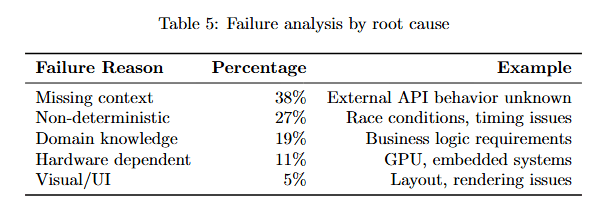
Table 5 categorizes failure modes by root cause, showing where current AI debugging hits fundamental limits. External context (38%) represents the largest failure category. When bugs depend on external API behavior, third-party service quirks, or runtime environments that Chronos cannot observe or simulate. Non-deterministic issues (27%) like race conditions and timing bugs remain hard because they require reasoning about all possible execution interleavings. Domain knowledge (19%) failures occur when correctness depends on business rules or regulatory requirements not encoded in the codebase. These failure patterns inform the research roadmap: improving external context modeling, better non-deterministic reasoning, and incorporating domain-specific knowledge bases.
The Future of AI Debugging: Where We're Heading
While Chronos represents a significant breakthrough with its 67.3% success rate, the real excitement lies in what comes next. The architecture and training methodology pioneered here open entirely new possibilities for automated software maintenance.

Figure 11 maps the projected trajectory of AI debugging capabilities from 2024 through 2030, overlaying actual performance data (solid blue line) with projected future capabilities (green dotted line). Starting from near 0% in 2024 when the research began, Chronos v1 (Stage 1: Reactive) achieves around 67% success by 2025. The steep initial climb reflects the breakthrough of purpose-built debugging architecture. Stage 2 (Proactive, 2026-2027) projects gradual improvement to around 85% as the system begins identifying bugs during code review rather than after deployment. The curve flattens somewhat here because proactive debugging requires predicting failures before they occur, a fundamentally harder problem. Stage 3 (Preventative, 2028-2030) shows continued but slower growth toward 95%+ success, approaching but never quite reaching 100%. This reflects the theoretical limits where some bugs will always require human judgment about intent, business logic, or domain-specific knowledge. The projection is grounded in current research trajectories and assumes continued advances in causal reasoning, multi-modal integration, and formal verification techniques.
The success of Chronos points toward three evolutionary stages in AI debugging capabilities, with corresponding success rates and timeframes. The current paradigm (write code, find bugs, fix bugs) is fundamentally reactive. The future involves three evolutionary stages:
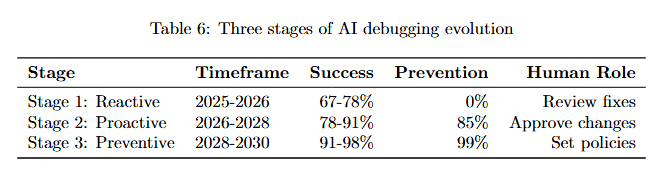
Table 6 outlines the evolution of AI debugging across three stages. Stage 1 (Reactive, 2025-2026) is where we are now with Chronos v1, fixing bugs after they're discovered with 67-78% success but 0% prevention. Stage 2 (Proactive, 2026-2028) will identify potential bugs during code review, suggest defensive coding patterns, and predict failure modes before deployment. Estimated 76-91% success with 85% bug prevention rate. Stage 3 (Preventative, 2028+) will generate inherently bug-resistant code structures, use automatic formal verification, integrate self-healing systems, and adapt to prevent failures before they occur, targeting 91-98% success with 99% prevention. Each stage shifts human roles from reactive fixing to proactive policy-setting, ultimately making debugging disappear entirely from the developer experience.
Stage 1: Reactive Debugging (Current - Chronos v1) We're here now. Fix bugs after they're discovered with 67.3% success rate and 42-minute average fix time.
Stage 2: Proactive Debugging (2026-2027) Identify potential bugs during code review, suggest defensive coding patterns, predict failure modes before deployment. Estimated 85% bug prevention rate.
Stage 3: Preventive Architecture (2028+) Generate inherently bug-resistant code structures, automatic formal verification integration, self-healing systems that adapt to prevent failures. Target: less than 1 bug per 10,000 lines of code.
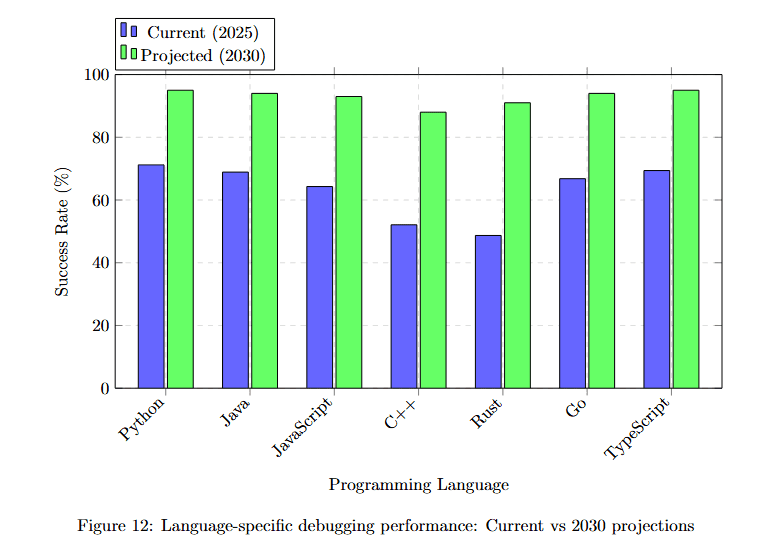
Figure 12 compares Chronos's current debugging success rates (blue bars) versus projected 2030 capabilities (green bars) across major programming languages. Python shows the strongest current performance at around 68% success, likely because Python's dynamic nature and extensive debugging tooling provide rich training data. JavaScript follows at around 66%, benefiting from the massive corpus of web development bugs. C++ shows lower current success at around 52%, reflecting the complexity of memory management and undefined behavior. Rust performs at around 48%, challenged by its sophisticated type system and ownership semantics that require deep compiler integration to debug effectively. Go sits at around 63%, while TypeScript achieves around 65%. The green bars show projected 2030 improvements reaching 90-95% across all languages, suggesting that as debugging architectures mature, language-specific challenges will diminish. The relatively uniform target heights indicate that future systems will achieve language-agnostic debugging through better causal reasoning rather than pattern matching syntax.
The ultimate goal isn't just better debugging. It's making debugging disappear entirely from the developer experience. Future AI debugging will be continuous and automatic, running in the background during development, fixing issues before developers notice them, learning from every keystroke and code change.
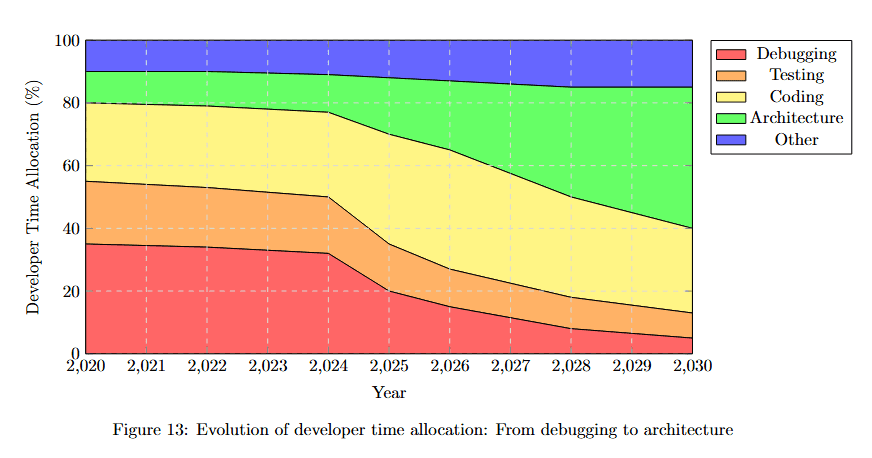
Figure 13 visualizes the fundamental transformation in how developers will spend their time as AI debugging matures. In 2020, debugging (red area) consumed roughly 40% of developer time, with testing (orange) at 20%, coding (yellow) at 25%, architecture (green) at 10%, and other activities (blue) at 5%. As we progress toward 2030, debugging shrinks dramatically to under 10% of time allocation, while architecture expands to nearly 35%. This inversion reflects a profound shift in the developer role. As AI handles the mechanical work of finding and fixing bugs, human developers focus on higher-level concerns: system design, performance optimization, security architecture, and strategic technical decisions. Testing (orange) also shrinks as AI-generated tests become more comprehensive. Coding (yellow) remains relatively stable but shifts toward implementing complex business logic rather than debugging infrastructure. By 2030, the developer experience transforms from reactive firefighting to proactive system design, with AI debugging running silently in the background, catching and fixing issues before they ever reach human attention.
Several fundamental challenges remain:
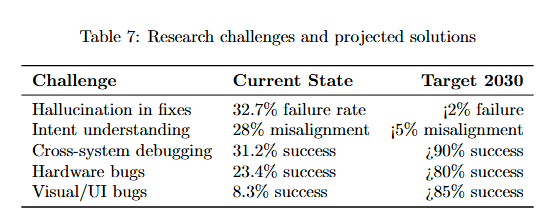
Table 7 identifies the key research challenges and ambitious 2030 targets. Hallucination in fixes (currently 32.7% failure rate) must drop below 2% before AI debugging can be trusted in safety-critical systems, requiring better confidence calibration and validation loops. Intent understanding (28% misalignment) occurs when Chronos fixes the symptom but misses what the developer actually wanted. Target is less than 5% misalignment through better developer feedback loops. Cross-system debugging (31.2% to greater than 90%) requires modeling distributed system behavior across network boundaries. Hardware bugs (23.4% to greater than 80%) need integration with hardware simulators and specifications. Visual/UI bugs (8.3% to greater than 85%) require multimodal capabilities to "see" and understand visual rendering. These targets are aggressive but grounded in clear technical pathways.
The Hallucination Problem in Fixes: Current models, including Chronos, occasionally generate fixes that appear correct but introduce subtle new bugs. Future research needs to achieve near-100% reliability through formal verification integration and probabilistic correctness guarantees.
Understanding Developer Intent: Bugs often stem from misaligned implementation and intent. Future systems need to understand not just what the code does, but what it should do, requiring natural language specification parsing and behavioral contract inference.
Cross-System Debugging: Modern applications span multiple services, databases, and platforms. Future debugging must handle distributed system traces, microservice interactions, and cloud-native architectures.
From Specialized Tools to Unified Intelligence
Current AI development tools operate in isolation. Code generation doesn't know about production bugs. Debugging tools don't understand original intent. Testing frameworks lack historical context. This fragmentation forces developers to manually translate between systems and causes each tool to rebuild understanding from scratch.
The solution is convergence. Just as computers unified separate calculation, storage, and output machines, AI development tools must integrate into systems that understand code holistically.
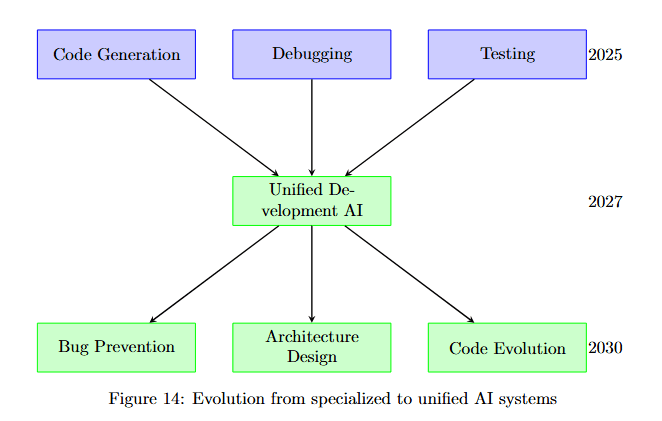
Figure 14 illustrates the architectural evolution toward unified AI development systems. Currently (2025), Code Generation, Debugging, and Testing exist as separate specialized tools, each optimized for its specific task. By 2027, these converge into a Unified Development AI that handles all three functions through shared understanding and context. This unified system then branches (by 2030) into three integrated capabilities: Bug Prevention, Architecture Design, and Code Evolution. This progression reflects a fundamental insight: debugging, generation, and testing are not separate problems but different views of the same underlying challenge (understanding code intent and behavior). The unified architecture enables each capability to inform the others. Code generation benefits from debugging knowledge about common failure modes. Testing strategies improve through understanding of historical bugs. Bug prevention leverages both generation patterns and test coverage insights. This convergence eliminates the friction of context-switching between tools and creates a seamless development experience where AI handles mechanical tasks while developers focus on architecture and design decisions.
This architectural convergence addresses one of the core problems with current AI coding tools: they operate in isolation, each with incomplete context. When GitHub Copilot generates code, it doesn't know about the bugs that similar patterns have caused in production. When traditional debugging tools analyze failures, they don't understand the original intent behind the code generation. When testing frameworks validate behavior, they lack insight into the historical debugging patterns that reveal edge cases. Chronos represents the first step toward this unified future by embedding debugging-specific knowledge into its architecture. But the real breakthrough comes when debugging insights flow back into generation (preventing bugs before they're written), inform testing strategies (focusing on historically problematic patterns), and enable evolutionary code improvements (automatically refactoring code to eliminate entire bug categories). By 2030, developers won't interact with separate tools for generation, debugging, and testing. They'll work with a single unified system that understands code holistically, learning from every bug fixed, every test written, and every feature deployed to continuously improve all aspects of the development workflow.
The Economic Imperative
AI debugging isn't just technical progress. It's economic transformation. Debugging currently consumes 35-40% of developer time. For the global software industry (27 million developers), that's over $400 billion annually in direct costs. Indirect costs (production incidents, delayed launches, technical debt, lost morale) likely exceed $1 trillion.
The value compounds exponentially. Time saved on debugging accelerates feature delivery, which generates earlier revenue, which funds more development. Production incidents prevented preserve customer trust and brand reputation. Features unblocked by faster debugging capture competitive advantage.

Figure 15 projects the economic impact of AI debugging capabilities through 2035, measured in billions of dollars. The analysis tracks three components: Cost Savings (blue line) from reduced debugging time and fewer production incidents, Productivity Gains (green line) from developers freed to work on higher-value tasks, and Total Impact (red dotted line) combining both effects. Starting near zero in 2025 with Chronos's initial release, Cost Savings grow steadily to around $200B by 2030 and $300B by 2035 as enterprise adoption scales. Productivity Gains show steeper exponential growth, reaching around $250B by 2030 and $450B by 2035, reflecting the compounding effect of developers shifting from reactive debugging to proactive architecture and innovation. The Total Impact curve (sum of both) projects roughly $100B by 2027, $450B by 2030, and approaches $1 trillion by 2035. This trillion-dollar projection assumes continued improvements in debugging success rates, expansion to new bug categories, and broad enterprise adoption. The economic impact extends beyond direct time savings to include reduced production outages, faster time-to-market for new features, improved software reliability, and decreased technical debt accumulation across the global software industry.
These projections connect directly to the transformation shown in Figure 13, where developer time shifts from debugging to architecture. When debugging consumes 40% of developer time at an average fully-loaded cost of $150K per developer, the global cost exceeds $400B annually. As AI debugging reduces this to under 10%, those savings compound with productivity gains from developers focused on higher-value work. The trillion-dollar impact by 2035 isn't just about doing the same work faster. It's about unlocking entirely new categories of software innovation that were previously blocked by debugging bottlenecks.
A New Paradigm for Software Debugging
Chronos represents an important step forward in addressing the debugging challenges of modern software development. By training specifically on debugging tasks rather than general code completion, it achieves performance levels that demonstrate the value of specialized approaches: 67.3% debugging success rate, 78.4% root cause accuracy, and the ability to handle complex multi-file debugging scenarios.
The insights from Chronos's development suggest several important principles for future work. Specialized training on debugging data produces dramatically better results than general-purpose models. Real debugging data from actual sessions provides invaluable training signal. Task structure matters, understanding debugging as causal reasoning rather than sequence prediction is crucial. Multi-modal integration of code, logs, tests, and documentation reflects real-world complexity. And learning from failures through iteration leads to better solutions.
As we continue to develop these systems, we can expect gradual improvements in debugging automation. The current achievements demonstrate that specialized AI can understand and fix code at levels approaching human expertise in many scenarios. While challenges remain, particularly with hardware-dependent bugs and distributed systems, the trajectory suggests continued progress toward more reliable automated debugging.
Key technical contributions from the Chronos research include domain-specific pre-training on 15 million debugging instances including stack traces, fix commits, and CI/CD logs, Adaptive Graph-Guided Retrieval (AGR) that outperforms advanced RAG techniques like HyDE, Self-RAG, and FLARE by 2-3x on debugging tasks, a persistent memory architecture that maintains cross-session knowledge, and an autonomous debugging loop with iterative refinement based on test execution feedback.